Wednesday, 1 June 2011

TEA WITH MISS POPPINS

I was going to tea with Mary Poppins!

Well, no, not exactly, but I was going to tea with P L Travers, who had written the Mary Poppins books and, at that precise moment, I was walking down a street of neat-and-tidy-looking houses that reminded me very much of Cherry Tree Lane…

True, Shawfield Street - off the King’s Road in London’s Chelsea – didn’t boast any really grand houses (with two gates) like that owned by Miss Lark and none of them were quite as unusual or as exciting as the ship-shape home of Admiral Boom… But, as I arrived at the door of number 29, I felt as if I might expect to find Robertson Ay asleep on the doorstep or hear the argumentative voices of Mrs Brill and Ellen coming up from the basement…

This all happened twenty-four years ago, but I remember it now as vividly as if it had only happened yesterday…

I’d been invited to come to tea at four o’clock and I was a little early – ten minutes early to be precise – because I really didn’t want to be late and keep Mary Poppins waiting...

I went up the steps to the front door – which, rather surprisingly, was painted candyfloss pink – and I rang the bell.

Silence.

I rang again.

Still silence.

Had I got the wrong day, I wondered.

Then a window, two storeys up, flew open and a head popped out and asked, in a brisk tone, “Are you Brian Sibley?”

I said that I was.

“Well,” said the head, “you are early!” And the window rattled shut again.

I waited. And I waited. For the full ten minutes I waited - until the clock on a nearby church struck ‘four’. Only then did a woman with curly grey hair and bright forget-me-not blue eyes open the door.

So, this was P (for Pamela) L (for Lyndon) Travers…

I noticed that she was wearing a pair of ‘sensible shoes’ of the kind Mary Poppins wore; but, in contrast, she sported a very un-Poppinsish dress with lots of frills and flounces, a number of jingly-jangly bracelets and bangles (rather like those favoured by Miss Lark, I thought) and a chunky turquoise necklace.

After my wait on the doorstep, I was a little nervous, but she welcomed me in with a smile, threw my coat over the back of a noble rocking-horse who galloped up the hallway and showed me into the room where, many times afterwards, I would come to have tea and talk with the woman who introduced the world to Mary Poppins.

When Jane and Michael Banks once asked Mary Poppins who she would choose to be if she wasn't Mary Poppins, she replied, in her sharp, non-nonsense tone: “Mary Poppins.” It is a typical Poppins response: supremely confident, yet - at the same time – as mysterious and elusive as the place where a rainbow ends…

And, sometimes, P L Travers could be much the same.

For one thing, that was not her real name: when she was born, in Australia in 1899, she was called Helen Lyndon Goff.

Then, as a young woman she became an actress and a dancer and took a ‘stage name’: “Pamela” (which she thought sounded pretty and actressy), “Lyndon” (her own second name and a reminder that her ancestors came from Ireland, the land of myths and stories) and “Travers” which was her father’s first name.

He had died when she was seven years old and she never forgot how much she had loved him and missed him.

I think Mr Banks in the stories is, probably, rather like her father and although Pamela used to tell people that he was a sugar-planter in Australia, at the time that she was born he was working in a bank – just like Jane and Michael’s father.

Pamela usually got irritated if you talked about her having ‘created’ Mary Poppins. She preferred to say that she had ‘discovered’ rather than ‘invented’ her, but as with so many things in Pamela’s life, you never quite knew…

She told me, for instance, that Mary Poppins had first blown into her imagination – rather as she blows into the lives of the Banks family – when she was recovering from an illness in an old country cottage in Sussex.

She said that somewhere - in that strange state between being ill and getting better – the idea of a person like Mary Poppins had come to her.

The truth, however, is that several years earlier she had written a short story called ‘Mary Poppins and the Match Man’ that was published in a New Zealand newspaper.

This story was an early version of the second chapter of Mary Poppins in which Bert accompanies her on her ‘Day Out’ and they enjoy a wonderful tea with heaps of raspberry jam-cakes! It would become, years later, part of the 'Jolly Holiday' sequence in Walt Disney's film of Mary Poppins.


Anyway, during that illness, she obviously thought up some new stories and wrote them down and the first book, Mary Poppins, was published in 1934, with illustrations by Mary Shepard, the daughter of the man who drew Winnie-the-Pooh.
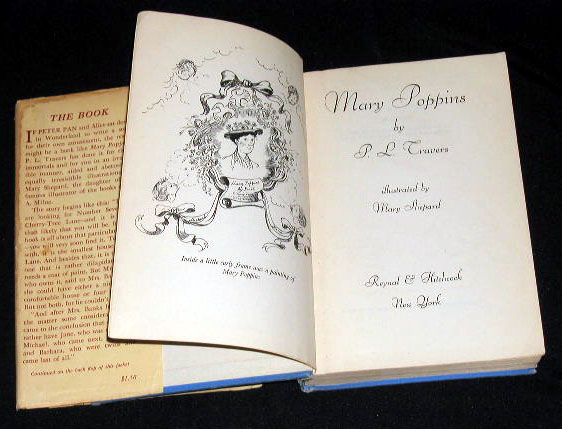

The following year, she wrote her second book, Mary Poppins Comes Back and, then after a nine-year gap, the third book in the series appeared. Pamela had wanted to call it Good-bye, Mary Poppins, but eventually – after her publisher begged her not to be quite so final - it was renamed Mary Poppins Opens the Door.

And, as it happens, it wasn’t goodbye to Mary Poppins because, eight years later, P L Travers wrote Mary Poppins in the Park and the practically perfect nanny then reappeared in various spin-offs including an alphabet book Mary Poppins from A to Z (which, for some reason, was later translated into Latin) and a book of stories and recipes entitled Mary Poppins in the Kitchen. Late in life, the author wrote two more slim volumes: Mary Poppins in Cherry Tree Lane and, finally in 1988, Mary Poppins and the House Next Door.
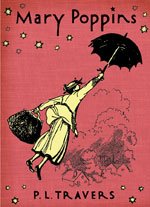
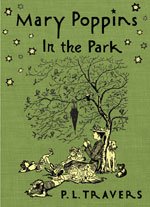
“If you are looking for autobiographical facts,” P L Travers once wrote, “Mary Poppins is the story of my life.” This seems an unlikely claim when you think that Mary Poppins goes inside a chalk pavement picture, slides up banisters, arranges tea-parties on the ceiling and has a carpet bag which is both empty and yet contains everything.

But, if we take her at her word, we can find many things in her books that spring from her own life and shaped the stories she told…

For example, several of her fictional characters have names borrowed from people Pamela had known in her childhood - among them a strange little old woman with two tall daughters who ran the local general store where the young Pamela bought sweets. Her name, of course, was – as it is in the stories - Mrs Corry.

As for Miss Poppins herself, her first name was probably inspired by the younger of Pamela’s two sisters who was known in the family as ‘Moya’ – the Irish version of ‘Mary’.

As for ‘Poppins’… Well, Pamela never gave any clues as to where that name came from. But when she first arrived in London to work as a journalist, she used an office near Fleet Street and on her way to visit nearby St Paul’s Cathedral – home to the Bird Woman – she would have passed a little lane with the curious name, ‘Poppins Court’.
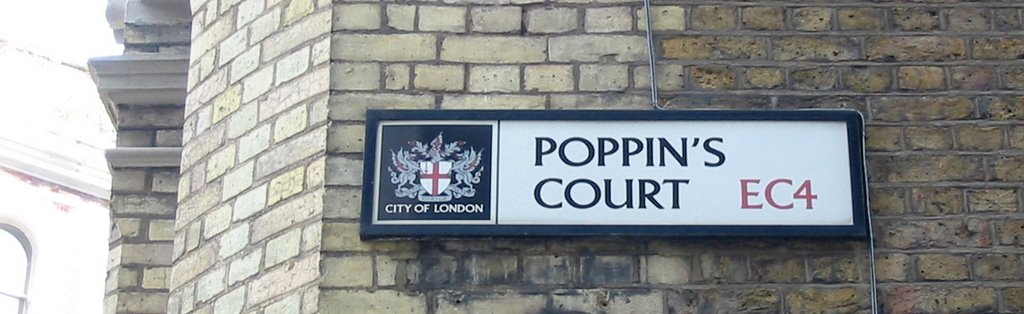

Unlike today's street signs, early London gazetteers did not include the apostrophe and Poppins Court was once the site of a 14th Century inn called ‘The Poppinjay’ that was owned by the Abbots of Cirencester and had an inn-sign displaying the Abbey's crest: a parrot-like bird.

And while we're talking parrots, as it were...

Although she and her sisters never had a Mary Poppins for a nanny, they did have an Irish maid named Bertha --- or maybe she was called Bella, Pamela could never quite remember! Bella (or Bertha) was a marvellous character with almost as many eccentric relatives as Mary Poppins.

What’s more, Bertha – or Bella – possessed something that was her pride and joy: a parrot-headed umbrella. "Whenever she was going out," Pamela once told me, "the umbrella would be carefully taken out of tissue-paper and off she would go, looking terribly stylish. But, as soon as she came back, the umbrella would be wrapped up in tissue-paper once more.”

You will remember that Mary Poppins always carried her umbrella, regardless of the weather, simply because it was too beautiful not to be carried. “How could you leave your umbrella behind,” asks the author, “if it had a parrot’s head for a handle?”

"Spit-spot into bed," was a favourite phrase of her mother's, and other bits of Mary Poppins' character were clearly inspired by Pamela's spinster aunt, Christina Saraset, whom everybody called 'Aunt Sass'. She was a crisp, no-nonsense woman with a sharp tongue and a heart of gold who, like Mary Poppins, was given to making "a curious convulsion in her nose that was something between a snort and a sniff."

When Pamela once suggested to her aunt that she might write about her, the elderly lady replied: "What! You put me in a book! I trust you will never so far forget yourself as to do anything so vulgarly disgusting!" This indignant response was followed up with a contemptuous, "Sniff, sniff!" Now, doesn't that sound just like Mary Poppins? Equally, it might have been P. L. Travers herself who said something along the same lines to me, when I rashly suggested, one day, that I might write her life-story!

As a young girl, Pamela took dancing lessons and there seems to be dancing, of some kind or other, in every one of the books - remember Mary Poppins joining all the birds and beasts at the zoo in dancing the Grand Chain? Or the Red Cow who catches a falling star on her horn and can’t stop dancing?
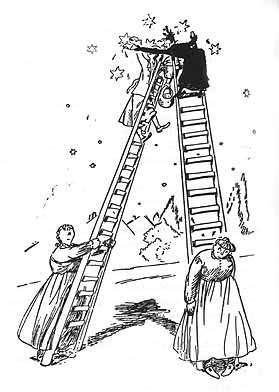
And, speaking of stars, reminds me that as a child Pamela had been captivated by the beauty of the constellations she saw in the clear southern skies above her home in the Australian outback.

She never lost her fascination with star-gazing and there are stars scattered throughout the pages of all her books. In one story, Mrs Corry, her two gargantuan daughters and Mary Poppins paste Gingerbread Stars on to the night sky and in another, Maia (one of the stars in the constellation known as the Pleiades), comes down to earth to do her Christmas shopping.

Over the years that I knew Pamela we had many conversations but the one I remember most clearly took place not long before she died at the grand age of 96 and it was also about a star.

I had asked her if she thought perhaps another story - maybe one last tale about Mary Poppins - might come to her. “I think it might,” she replied slowly, “because, the other day, on the street outside, I found a star on the pavement!”

“A star?” I repeated, with surprise.

“Yes,” she said softly, “a star. Go and look for it yourself. I hope I shall find out where it came from and what it is doing there.”

It was dusk when I let myself out of the candy-pink door of 29 Shawfield Street and headed off to look for that star. Light was failing, but I found it, at last: just as Pamela had said - a star-shape, faintly but clearly marked in the surface of a paving stone.
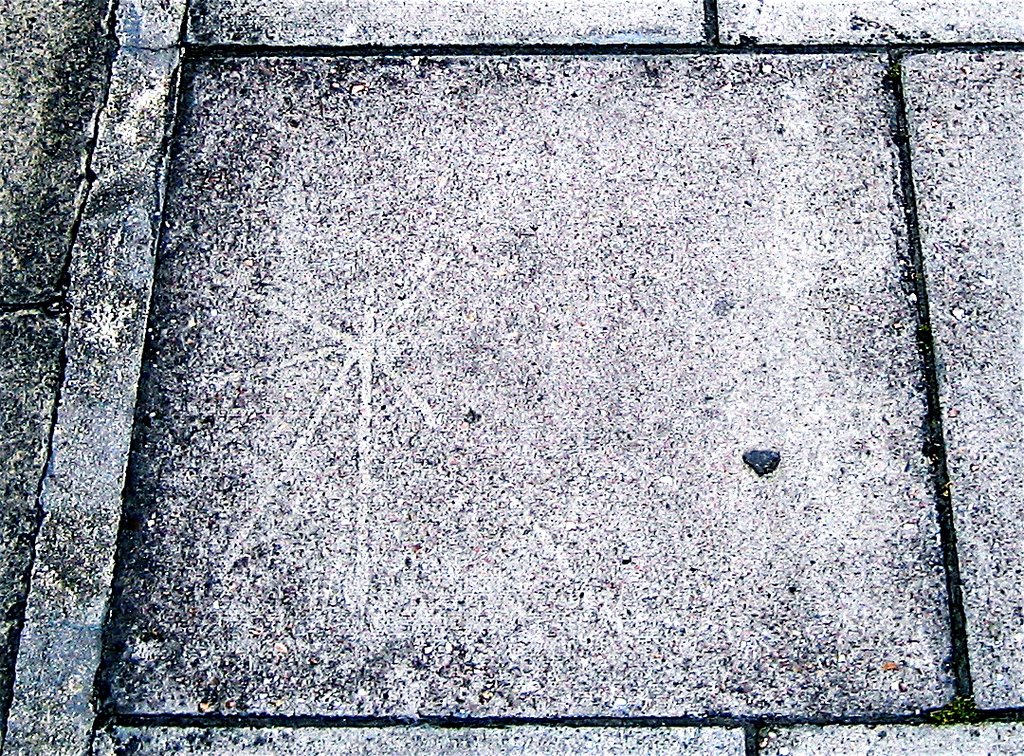

A puzzled passer-by looked quizzically at the man staring intently at what looked like a very ordinary pavement. But I was remembering the words of the old snake, the Hamadryad, on that night of the full moon when Mary Poppins took Jane and Michael to the zoo:
“We are all made of the same stuff... The tree overhead, the stone beneath us, the bird, the beast, the star - we are all one, all moving to the same end...”
Like Mary Poppins, P L Travers saw - and gave others the ability to see - the magical in very ordinary and everyday things.

She had discovered something as rare and amazing as a star in a London street and, then, she had given it away...

I hope she found out why it was there…

Of course, Mary Poppins would have the answer, but, as you know, she would never, never tell...


A version of this reminiscence was first published, five years ago, on my blog, Ex Libris: Brian Sibley.

Monday, 30 May 2011

MICKEY MONDAYS: Weekly Manifestations of the Mouse

As used by Mr Mouse for the keys to the Magic Kingdom...

Mickey Key-Ring


Monday, 23 May 2011

MICKEY MONDAYS: Weekly Manifestations of the Mouse

This French-made chinaware plate, was purchased at the opening weeks of EuroDisneyland (later Disneyland Paris) in 1992.

In the movies, Mickey Mouse' eventually lost his tail as an animation economy; here he has the longest tail ever – running round the entire edge of the plate!

Axis Mickey Plate

Axis Mickey Plate (Back logo)


Friday, 20 May 2011

THE PUPPET'S PROGRESS

My recent post on the naming of Jiminy Cricket has prompted me to write about what is, pretty much, my all-time favourite Disney film...


...which is why I was so delighted, back in 2009, to get the opportunity to officially enthuse for the No Strings Attached, 'Making of...' feature on the 70th Anniversary DVD release of the film. And, indeed, here I am, caught on a screen-grab, in mid-gab...


I recently watched Pinocchio again (although, over the years, I must have seen it close on sixty times) and having now seen it yet one more time – in that last sparkling restoration filled with the richest colours and deepest shadows – I'm even more certain that this film is not just one of the great masterpieces of animation but also a great movie in any genre.


I first saw Pinocchio from the front row of the circle in the Odeon, Bromley, Kent, sometime in the early ‘sixties, when it was already on its umpty-umpth re-release. So entranced was I that I went back to see it again and again - and again!

This, of course, was in the days of 'continuous performances' which meant that I was able to watch Pinocchio no fewer than eight times in one week!


Teaching myself to write in the dark, I filled an entire notebook with minute observations about the animation, the structure of the storytelling, the set-pieces and effects and the incredible richness of detailing such as Geppetto's incredible array of carved clocks (above) that create an intense - almost claustrophobic - atmosphere of fantastical reality that swallows up the viewer as surely as Monstro the Whale has swallowed up Geppetto's boat.


The painting above (and the one below), by the Swedish artist, Gustav Tenggren, are two of many pieces of inspirational art which helped create the ornately sumptuous styling of the film that is, essentially, a European picture book come to life.


Pinocchio was released in 1940, just two years after Disney's first animated feature, Snow White and the Seven Dwarfs, and the picture undoubtedly benefited not just from all the lessons learned in animating Snow White, but also from the fact that the huge financial success of that debut outing made it possible for serious money to be spent on developing the studio's second feature. The refinement of craft and increased expenditure can be seen in almost every sequence of Pinocchio.

Nevertheless, he two films could scarcely be more different: the first has freshness, exuberance and a naïve innocence that no Disney feature would ever re-capture; the second is more a more mature and studied piece of film-making, bolder and braver in breaking with the sweet formula of the fairy tale and in creating a cast of characters, a number of whom have an ambiguous morality.

Like the book, the film is a picaresque tale in which Pinocchio's journey (similar in didactic tone to that of Christian in John Bunyan's The Pilgrim's Progress) is fraught with disturbing encounters, difficult choices and painful self-discoveries.


Then there is the tone and look of the film. Despite the occasional scary moments Snow White and the Seven Dwarfs is essentially a light, airy film, whereas Pinocchio is dark and sombre…

It runs for just under an hour and a half and yet less than 15 minutes of that time takes place in daylight: the rest is made up of sinister night sequences and scenes shot underwater and within the gloomy, vaulted, cathedral-like interior of the whale.


There are scenes of menace and sheer out-and-out terror: Pinocchio cowering in a cage as Stromboli the puppet-master tells him that he will make a lot of money and when he is no longer any good he will make excellent firewood - a warning which he demonstrates by hurling a hatchet into the body of a lifeless puppet lying in a basket of wood...


Or, again, the scene in the dingy, smoky interior of the Red Lobster Inn where the Coachman reveals his scheme for abducting naughty little boys and taking them to Pleasure Island, his fat, flabby face transforming into a leering demon that terrifies even the crooked Honest John.


Above all, there is the shocking moment when the tough-kid, Lampwick, begins to transform into a donkey: running amok in the pool hall, kicking over chairs and tables and smashing mirrors with his newly-developed hooves.


True, at the end of the film there is a happy ending for Pinocchio, but not for Lampwick or for the other donkey-boys who have been crated up and sent to the salt mines.

A number of sequences carry a terrible sense of desolation: the ruins of Pleasure Island after the boys have reeked havoc and destruction; and the dusty interior of Geppetto’s deserted workshop after he has gone off to look for his missing boy.

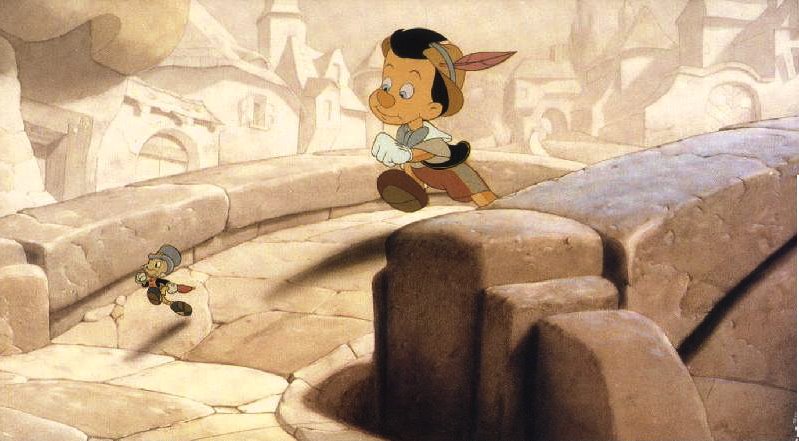
Magically, the film juggles the terrifying with the funny, the harsh with the sentimental. And the forces of malevolence, whilst being an ever-present threat, are always counterpointed by the constancy of Geppetto and the loyalty of the temperamental but big-hearted Jiminy Cricket, who begins the film as a storyteller but then steps into the story itself not just as Pinocchio's conscience but also as the audience's guide and companion.


When Geppetto wishes on the Wishing Star that Pinocchio might become a real boy, Jiminy observes: “A really lovely thought but not all practical…” And when the Blue Fairy does, indeed, endow the puppet with life, he says with genuine astonishment, “What they can’t do these days!”

The Jiminy device (unique to the film since – as I mentioned in my last post – Carlo Collodi, originally had Pinocchio flatten the Talking Cricket with one of Geppetto's mallets!) gives immediacy to the tale so that it appears to be a first hand recollection, a true story that really happened.


We ought to wonder about the oddness of it all - a sharp-talking, street-wise, American commentator who looks hardly anything like a real cricket and basically is only a cricket because we are told that he's a cricket. But we accept it entirely at face value despite the fact that this spunky little insect-man is providing a commentary on a story that unfolds in a quaint, old-fashioned European world that is less like Collodi's Italy than somewhere on the borders of Switzerland and Germany.


The use of the Multiplane camera, that had been employed only sparingly in Snow White, gives Pinocchio great depth as can be seen in the opening pan across the moonlit rooftops and the spectacularly elaborate sequence of the hustle and bustle of the village coming awake to the sound of the school bell: the camera moves among the knotted jumble of streets and squares to reveal children running, laughing and playing at the pump; a mother giving a child's face a final scrub; an old man smoking his pipe; a baker going on his rounds; a goose girl driving her geese...


The animators also made skillful use of visual perspectives as in the shot filmed from Jiminy’s point of view as the camera - along with the cricket - literally hops towards the lighted window of Geppetto's workshop.

As for the special effects, they proliferate and are stunning: fire, smoke, lightning and rain; the Blue Fairy's magic wand; the distorted view of Pinocchio through Cleo’s goldfish bowl; Jiminy floating down on his umbrella reflected on the convex surface of Monstro’s eyeball; and the extraordinary sea scenes: the waves, wind and foam, the uproar of surf churned up by the enraged Monstro and the picturesque underwater landscape filled with reflections, bubbles and swirling shoals of fish...


Pinocchio is a tour de force of economic storytelling: compressing the many exploits in Collodi’s book into a single, compelling narrative, told in part through the music and songs that help delineate character and advance the plot: the fraudulent Honest John's 'Hi-diddly-dee, an Actor's Life for Me'; Pinocchio's 'There Are No Strings On Me', an ironic song of freedom sung just before his imprisonment by Stromboli; and Jiminy Cricket's 'Give a Little Whistle' and the opening and closing ballad, 'When You Wish Upon a Star' (movingly rendered by Jiminy's voice, Cliff Edwards) which became - and remains - the anthem of the Disney studio.


At the end of the film, Pinocchio the puppet becomes a real boy and whilst he is nowhere near as appealing as he was as Geppetto's "little wooden-head", the old woodcarver, along with Figaro and Cleo, seems very happy about the transformation.

I, too, am content, since every time I watch Pinocchio, I am transported back to the front row of the circle in the Odeon, Bromley, and also become (albeit briefly) a real boy once more...


Monday, 16 May 2011

MICKEY MONDAYS: Weekly Manifestations of the Mouse

A Mickey pen from Disneyland Paris – for keeping notes on your sorcery experiments!

Mickey Pen (1)

Mickey Pen (2)

Many thanks to Lesley for this item of Mouse merchandise.


Thursday, 12 May 2011

"CRICKET'S THE NAME!"


"What is your name?"

"Oh, Cricket's the name. Jiminy Cricket."

One of the inevitable facts about famous books becoming famous movies is that, sometimes, it can be difficult to remember what was in the original and what was added or adapted during the process of Hollywoodisation.

Several Disney films could serve as a case in point: ask anyone to name the Seven Dwarfs and they would manage at least four or five; and yet, those little men had no names in any version of the fairy-tale uncle Uncle Walt retold it in 1937.

Similarly, the 1940 film, Pinocchio, reminds me that the name of the puppet's 'Official Conscience', Jiminy Cricket, has its own curious history...

When, in 1883, writer 'Carlo Collodi' (real name Carlo Lorenzini) began writing Le Avventure di Pinocchio for an Italian children's newsparer he included a brief encounter between the marionette and a Talking Cricket who, in those days, still didn't have a name.

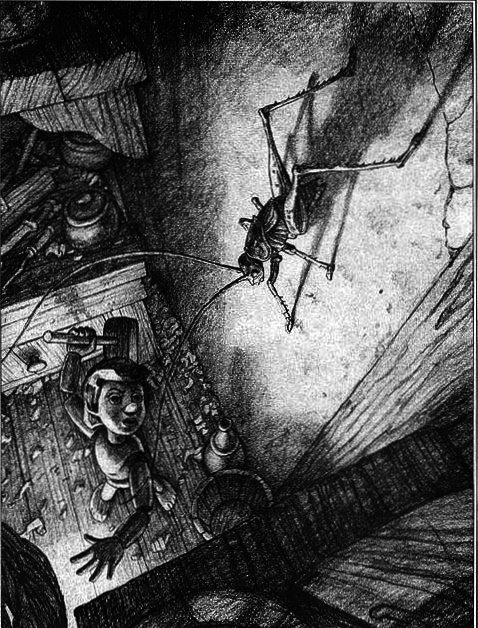
Pinocchio tells the Cricket that his ambition in life is to "eat, drink, sleep and amuse myself, and to lead a vagabond life from morning to night," and this prompts an outburst of weighty moralising by the Cricket who informs the puppet that: "As a rule, all those who follow that trade end almost always either in a hospital or in prison." This, in turn, leads to an exchange with an extremely ugly outcome...

"Take care, you wicked, ill-omened croaker! Woe to you if I fly into a passion!"

"Poor Pinocchio! I really pity you!"

"Why do you pity me?"

"Because you are a puppet and, what is worse, because you have a wooden head."

At these last words, Pinocchio jumped up in a rage and, snatching a wooden hammer from the bench, he threw it at the Talking-Cricket.

Perhaps he never meant to hit him, but unfortunately it struck him exactly on the head, so that the poor Cricket had scarcely breath to cry "Cri-cri-cri!" and then he remained dried up and flattened against the wall.

Later in the story, the Cricket's ghost comes back from the dead to do some more sermonising, but Walt Disney decided to keep the Cricket alive and to continue his spirited attempts at guiding Pinoke on “the straight and narrow path” throughout the movie.


Obviously, such a major character required a name… But the moniker 'Jiminy Cricket' wasn't Disney's invention; it was borrowed from an already everyday expression - dating back to 1848 - denoting puzzlement or surprise: “JIMINY CRICKETS!”

But, why Jiminy Crickets? Well, if you look at the initials of that name -- J. C. -- there's your answer…

Jiminy Crickets (or sometimes Jiminy Christmas) is a euphemistic alternative to swearing by the person whom the British writer and raconteur, Quentin Crisp, used to refer to as "Mister Nazareth"!

It seems likely that the origin of the expression was overlooked by Disney who had already allowed it to be used by the dwarfs in Snow White and the Seven Dwarfs (made three years before Pinocchio) when, on returning from their diamond mine, they discover that their home has been invaded by a princess with a penchant for cooking and cleaning!

Jiminy Crickets is an example of what is called a 'minced oath' - a kind of profanity chosen by those who would rather "mince their words", than risk giving offence…

So, instead of saying J**** C*****, you say Cheese and Rice, Jeepers Creepers, Jason Crisp, Judas Priest --- or good old Jiminy Crickets!

Other examples of 'minced oaths' include such Shakespearian expletives as 'Zounds', short for 'God's wounds' referring to the crucifixion, and 'Gadzooks', from 'God's hooks', or the nails in the cross.

By golly!, By gosh! and By gum! are all handy ways of NOT saying By GOD! And By Jove! is useful if you normally address the deity as Jehovah but want to avoid outright blasphemy.

On the other hand, the commonly used Drat! is a seriously shortened version of God rot it! which actually has a good deal more oomph to it and, in my opinion, really deserves to be reinstated into the language.

It should also be noted that Figs! and Fink! - should you happen to hear them used - are alternatives to the ubiquitous 'F' word - though, I'd guess, pretty much obsolete nowadays…

So, there you are: a bit of movie history and a lesson in etymology all in one!

Godfrey Daniels! What more could you ask?


[Image of Pinocchio and the Cricket by Greg Hildebrandt on Spiderwebart; the Crucifixion is by Dore]

A version of this post first appeared on Brian Sibley: his blog in 2006.

Tuesday, 10 May 2011

WINDOW OF OPPORTUNITY


For a great shot of a fantastic
stained-glass window
in Le Château de la Belle au Bois
(Sleeping Beauty's Castle)
in Disneyland Paris,
along with links to a couple of others
(like the one on the left)
visit my companion blog
Window Gazing.


Saturday, 7 May 2011

DISNEYLAND HISTORY UNFOLDS

A Disneyland souvenir from the '60s – this one was posted to the UK in 1966.

It is fascinating to think just how much has changed (and, in particular, how permanent some things look in these pictures that are long, long gone!) but also how much has remained exactly the same!

Looking at the "26 colorful scenes" on this concertina post-card, I find myself really wishing I'd seen Nature's Wonderland and had a go on the Flying Saucers. Never mind, I did see the original Fantasyland (before its 1983 face-lift) and had lunch on Captain Hook's Pirate Galleon!

This is Disneyland 1
This is Disneyland 2
This is Disneyland 3
This is Disneyland 4
This is Disneyland 5
This is Disneyland 6


This is Disneyland 7
This is Disneyland 8
This is Disneyland 9
This is Disneyland 10
This is Disneyland 11

Monday, 2 May 2011

BARKING UP THE WRONG TREE

Going under the hammer at O'Gallerie, Portland, Oregon, today at 7:00pm PST:

"Lot 180: An original Walt Disney watercolor and gouache on celluloid from the 1955 movie, The Lady and the Tramp (sic).

"Depicts Tramp seated beside a small fox on a tree stump."


Er... No! Not quite...

But good to know that Toughy and Pedro eventually escaped from that ghastly City Pound. Let's hope that Peg and the others were similarly lucky!

Friday, 29 April 2011

MEESKA-MOOSKA-MOUSKAMARRIAGE

On Royal Wedding Day 2011, here's another nuptial event...


This British sheet music for Edward Pola and Franz Vienna's novelty number was published in Britain in 1933 by Keith Prowse & Co. London. And, for the curious, here's what this delightful ditty sounded like...


Oh, yes, and many congratulations
and all good wishes
to

WILL & KATE!


Saturday, 23 April 2011

EASTER EGGSCELLENCE!

HAPPY EASTER!

WDW's Happy Easter Parade 1985


From Easter 26 years ago: this 8x10 black-and-white studio photograph has the following caption on the reverse:
WALT DISNEY WORLD'S HAPPY EASTER PARADE –– "Good Morning America's" Joan Lunden will join Mickey Mouse, Donald Duck and the Easter Bunny on Easter Sunday night for the ABC–TV broadcast of "Walt Disney World's Happy Easter Parade." The hour-long special will run April 7 at 7 p.m. EST and PST at 6 p.m. CST. (Copyright WALT DISNEY PRODUCTIONS 1985)

Monday, 18 April 2011

MARATHON MOUSE

From today's Metro newspaper reporting Mickey's participation in yesterday's London Marathon...


Wednesday, 13 April 2011

TRÈS BON

OK, some of the images are a bit off model-sheet (and Thumper seems to have got rid of his grey hairs!) but wouldn't it have been fun as a kid, back in the 'fifties, to have had a TV dinner off this jolly Disney tray?

'Gems from Disney' Tray

Manufactured in Britain in tinplate metal by Worcester Ware, the tray measures 31.5cm x 41cm (12.5" x 16.25"). From the prominence of Peter Pan and the presence of both Cinderella and Alice, I would guess that this was produced in 1953.


Saturday, 9 April 2011

GREETINGS FROM 3D-LAND

This is what 3D looked like 45 years ago: a lenticular postcard purchased in Disneyland in 1966...

Greetings from Disneyland

Greetings from Disneyland (Verso)


Monday, 4 April 2011

IN POOHSPECTIVE

Tubby Little Cubby All Stuffed with Fluff

“Winnie the Pooh,” says his animator, Mark Henn, “is deceptively simple in his design, but successful animation is about the character having a heart that feels and a mind that thinks. Unless you can capture that you are just simply moving lines around.”

Talking about animating this now world-renowned character, Mark points out that whilst Pooh may not necessarily be the most colourful character in the stories – Eeyore and Tigger seem to top most people’s list of favourites – he is, nevertheless, the centre of the world. As he puts it: “Some of the others maybe more multi-dimensional or have a greater range of emotions, but Pooh is the anchor and acts as a stabilizer on everybody else’s eccentricity.”

The new Disney feature, Winnie the Pooh opens in the UK, Europe and Latin America this month and in North America on 15 July.