Showing posts with label Walt. Show all posts

Monday, 26 May 2014

DISNEY COVER-UP

This from Didier Ghez's Disney History (vis Gary Apgar): the cover of Men Only (November 1951) featuring Walt Disney as 'Coverman...


...proving how difficult it can be to successfully cartoon a cartoonist – even for the hugely experienced Edward Sylvester Hynes

Here's the cover story...


Thursday, 6 March 2014

ON THE BOOKSHELF

However much you may think you know about Disney, Jim Korkis knows more and in his latest volume, The Vault of Walt Volume 2 he serves up another endlessly diverting potpourri of stories and anecdotes about Walt, his films, TV shows and parks. Like it's predecessor this is a classic bedside book – the perfect volume for dipping into with the guaranteed promise that wherever you dip you'll find some surprising new fact about movies, characters and theme park attractions that had somehow previously passed you by.


There are so many good reads in this book that it is hard to pick favourites: not surprisingly, I guess, I was particularly interested to read Jim's take on the the creative collision between Walt and P L Travers over Mary Poppins (now practically perfectly mythologised by the film Saving Mr Banks) but I also relished the behind-the-scenes detail on the making of those iconic Mickey Mouse projects, Steamboat Willie and 'The Sorcerer's Apprentice' sequence in Fantasia; the unfilled plans for Disney's idea of a train-travelling diorama show featuring scenes of turn-of-the-century American life and the background to the design and building of EPCOT's Spaceship Earth.

I digress for a moment, here, to relate how, on the night of the Epcot opening party, I was (due to my friendship with Disney legends John Hench and Marty Sklar) a lone British journalist amoung the tuxedoed VIPs (my colleagues were being entertained in 'Rosie O'Grady's' in downtown Orlando) I was wandering past Spaceship Earth when I bumped into Ray Bradbury and one of his daughters and he asked if I'd like to ride "his ride" with them! An unforgettable evening...

Anyway, back to Korkisland: every reader will have favourite sections, for me the best are those providing insights into the man, Walt Disney. This provides an important contribution to American (and world) culture as time marches on and only sexagenarians are be able – with authority – to say, yes, Virginia, there is (or was) a Walt Disney!

I'll leave the last word to the luminaries (well, all bar one!) who provide the opening testimonials for this excellent book...


Not Disney, but classic animation...

Did you grow up with Bullwinkle and Rocky. George of the Jungle, Dudley Do-Right and (the original) Mr Peabody and Sherman? These classic '50s TV cartoons were the creations of American animation producer, Jay Ward and are now celebrated in a new book, The Art of Jay Ward Productions.


Researched and written by veteran animator, Darrell Van Citters (Disney – Fox and the Hound – Warner Bros and his own studio Renegade Animation) who previously wrote the definitive book on the making of UPA's Mr Magoo's Christmas Carol, this is a sumptuous volume of 352 pages, jam-packed with character-sketches storyboard drawings, concept art, backgrounds and meticulously detailed information on the exceptional team of artists and talents who worked with Jay Ward to give us 'Fractured Fairy Tales', 'Tom Slick' and 'Super Chicken', and whose work ranks alongside the best of the Hollywood cartoon studios.

A 'must' for all animation fans, this engaging slice of cartoon life, brilliantly captures an era in the revolutionary graphic style so redolent of the 1950s and the zany scripts by Ward's co-producer, Bill Scott, that combined wacky knockabout fun with sophisticated puns.

And an added bonus: the book has a Foreword by the voice of Rocky (and sundry Disney characters, including Lucifer, Witch Hazel and Magica De Spell) –– the one and only Miss June Foray!


Sunday, 23 June 2013

MAN & MOUSE

Mickey and Walt as they were seen in 1935...


Wednesday, 30 January 2013

EVERYTHING IS SATISFACTUAL!


Here's a nice little item from my collection: a Brer Rabbit Painting Book, published in Britain in 1956, ten years after the release of Disney's Song of the South...


Based on Joel Chandler Harris' Uncle Remus stories, Song of the South is the Disney film that – in our politically correct modern society – dare not speak its name! 

Despite representing the plantation negro is a sympathetic light through a superb Oscar-winning performance from James Baskett and containing arguably far fewer negative racial stereotypes than the beyond-being-criticised Gone With the Wind, the movie languishes in the Disney vaults as an unreleasable embarrassment.

The film, of course, features one of Disney's best-loved and all-time iconic songs, 'Zip-a-dee-doo-dah', somewhat marred here by the addition of the sing-a-long elements but still enjoyable...


The fascinating behind-the-scenes story of the making of this now controversial film is the subject of a excellent new book from the respected Disney historian Jim Korkis, tantalisingly entitled Who's Afraid of Song of the South and Other Forbidden Disney Stories.


Korkis recounts the history of the project: its writing, casting, scoring, filming and animation  as well as evenhandedly discussing the films strengths and weaknesses and chronicling the controversy that has attended the film from the moment it received its premiere in Atlanta in 1946.

Ironically, as the author explains, this 'suppressed' film nevertheless became the inspiration for one of the Disney theme parks' most popular attractions, Splash Mountain, passed for development on the strict understanding that the exploits of Brer Rabbit and his arch-enemies, Brer Bear and Brer Fox could be featured but not their negro storyteller, Uncle Remus.

The 'Other Stories' in this well-researched collection are wide-ranging but equally intriguing, among them the fate of Sunflower, the missing black centaurette in the Beethoven 'Pastoral Symphony' segment of Fantasia; Disney's failed film project based on the Oz books of L Frank Baum; Walt's relationship with both Eisenhower and the FBI; the 'mystery' of Walt's last words and the Disney's studio's unlikely educational film productions telling The Story of Menstruation and the sex instruction movie, VD Attack Plan, both of which (unlikely though it seems) are available to curious eyes on YouTube...


Also included is an account of a forgotten 1930 Mickey Mouse comic strip in which the studio's leading rodent repeatedly (but unsuccessfully) attempts suicide; the background to the Disney TV shows devoted to space and studio animator Ward Kimball's belief in UFOs; and how Who Framed Roger Rabbit led the studio to create a Disney femme fatale who was a tad too hot to handle!

The collection is engaging and enlightening and Korkis has secured a distinct coup for a book that is largely devoted to a film that has fallen foul of the anti-racism lobby – it begins with a foreword penned by Disney Legend Floyd Norman: Disney's first black animator and storyman! 

The history of an empire as vast as that once presided over by Walt has been told many times – sometimes accurately but often not! – and few chroniclers have had the time to research, or the space to discourse on, every itty-bitty detail and all of the nitty-gritty facts. But sooner or later, Jim Korkis will winkle them out and share them with us. 

Anyone who has ever replayed the DVD of Pinocchio to look at all the clocks in Geppetto's workshop or who has ever scoured the Disney parks in search of hidden Mickey's, will relish Jim's work and should also snap up The 'Revised' Vault of Walt. 


This new and extended edition of an already popular book reveals the truth behind many more fascinating stories including accounts of the studio's first aborted attempt at filming Alice in Wonderland, Disney's abandoned collaboration with Salvador Dali on the film protect Destino, and such unconsidered (but delightful) trifles as all you need to know about Disney theme park carousels (including how to spot Julie Andrews' horse on the Disneyland merry-go-round) plus inside information on the Boss' favourite foods and his views on religion.

Walt is one of those individuals and his company is one of those organisations about which urban legends tend proliferate like heffalumps round a honey pot and with the art world's spotlight soon to be focused on David Glass' upcoming opera on Disney, The Perfect American, many of those legends – including the notorious Deep-Frozen Disney Myth – will be rehearsed anew.


Thank heavens Mr Korkis is on hand to debunk the nonsense and give us some genuinely intriguing mouse tales...  

You can order Who's Afraid of Song of the South, click here and The 'Revised' of Walt here

As for the fate of Song of the South, I have long held that the studio should grasp the nettle, turn to one or two of today's acclaimed black actors – Morgan Freeman, Denzel Washington, James Earl Jones, Will Smith, Jamie Foxx – and get them to contextualise the film for a DVD release that tackles head-on the prejudices that are preventing a new generation from enjoying this colourful, tuneful masterpiece of live action and animation. 

Meanwhile... There is an excellent website dedicated to all things connected with Song of the South that is well worth a visit.

Friday, 20 January 2012

WALT'S MY LINE?

Walt Disney's appears as the mystery guest on What's My Line?, 11 November, 1956.


Monday, 5 December 2011

MICKEY MONDAYS: Manifestations of the Mouse

Happy 110th Birthday
WALT DISNEY


Today's Mickey is Blaine Gibson's 'Partners' statue: a bronze likeness of the Mouse standing hand-in-hand with his creator in front of Sleeping Beauty's Castle, Disneyland.

Image: Brian Sibley

Monday, 28 November 2011

B.M.: 'BEFORE MICKEY'

A highly significant pen-and-ink drawing by Walter Elias Disney will go under the auctioneer's hammer on Wednesday 30 December in the Holabird-Kagin Americana 2011 Grand Final Auction to be held at the Atlantis Casino Resort, 3800 S. Virginia St., Reno, Nevada, 89502, United States.


Boldly drawn with great confidence and competence in the style of 'twenties comics, the drawing is a reminder that whilst in his later career, Walt didn't draw the 'cartoons' that carried his name, the young Disney was no slouch at the drawing-board!

Made in c. 1921 and measuring 8" x 4 3/4", the drawing is attached to a blue page with a heading titled 'Miscellaneous' from 'The Girl Graduate's Record Book' that belonged to Walt's sister, Ruth Disney Beecher. The reverse side of this page has "another work of art and a poem" signed Ipkigenia Gilhouse with the date '21, but it is the Disney sketch that has set the opening bid at a cool $17,500.00!

Many thanks to Michael Goldberg for telling me about the sale, though I doubt I'll be able to keep up with the bidding for long!

Thursday, 16 June 2011

MARY POPPINS AND THE SEA-CHANGE

Having recently written on this blog about P L Travers, I decided to revisit my 'archive' (one of many cardboard boxes!) and found a couple of items that may be of interest to Disneyphiles and Poppinsites.

My correspondence with P L Travers began in 1972 when I was writing Disneydust, a never-published biography of Walt Disney.

I had been working on this book in my spare time (I was then an employee of a finance company) for four years, inspired to redress what I saw as the skewed portrait of Walt in Richard Schickel's The Disney Version.

Considering I was on the wrong side of the Atlantic, I achieved quite a lot original research and contacted a number of veteran Disney artists and employees, several of whom would later become longstanding friends.

Being something of a bibliophile, I also wrote to the authors of some of the books that had been made into films by the Disney studio, including Dodie Smith, Mary Norton, Margery Sharp –– and P L Travers, from whom I received the following letter...

P L Travers - Letter 1972


Over the years, there has been much quoted comment about what was Pamela Travers' view of the the film. Here is how she expressed it in 1972...


P L Travers'  1972 statement on Disney 'Mary Poppins' film (1)

P L Travers'  1972 statement on Disney 'Mary Poppins' film (2)

Following her request, the statement was included in Disneydust in its entirety and Pamela read the chapter on the making of Mary Poppins and annotated it – extensively! As I have said, Disneydust never saw the light of day: abandoned by the publisher despite having advertised it in his catalogue of forthcoming titles – without my having a contract.

Fifteen years passed and I found myself working with Richard Holliss on The Disney Studio Story, for which I did have a contract! I wrote to Pamela asking if I could use her original statement in the forthcoming book. This is how she responded...

P L Travers - Letter 1987

P L Travers - Letter 1987 (Envelope)

Well, obviously, I was "minded to talk about the matter" and made the call that led to that first visit I have already described on this blog.

Part of Pamela's original statement eventually appeared in The Disney Studio Story (although heavily truncated since one-third of the text was lost in the edit) and my visits to 29 Shawfield Street continued and became more frequent until the day came when the subject of "another film" came up.

But that is a subject for another post...

Wednesday, 8 June 2011

TEA WITH MISS ANDREWS

It's one of those occasions when you have to pinch yourself and ask, "Is this really happening?"

I'm sitting in a suite in London's Dorchester Hotel with Julie Andrews - yes, the Julie Andrews – Mary Poppins! – who is asking, "Shall I be mother?" and pouring me a cup of tea.

"Sugar?" Just a spoonful...

Thirteen years ago, 1998.

Radio producer, Malcolm Prince, and I are finally about to have an interview for which we've waited weeks. It's been on, it's been off and, now, it's back on again...

Julie is in London, rehearsing with the cast of the new musical, Doctor Dolittle, in which she is providing the voice of Polynesia the Parrot, and she's agreed to give us an interview for a radio series we're making on Disney's Women - the real and fictional women in the life and films of Walt Disney.

The evening of the interview eventually arrives. We are on time - well, absurdly early, of course! - but Miss Andrews is delayed. Detained at rehearsals....

An hour passes. Then another... We sit in the Dorchester bar, drinking over-priced orange juice, not daring to risk any alcohol - just in case the interview actually happens! I'm unaccountably nervous. It feels how, I imagine ,it would feel if you were waiting for an audience with the Queen...

I look at my watch. It's getting late. Miss Andrews is now stuck in traffic. The interview will definitely get rescheduled... Then the call to go up to her suite.

If possible, I am now even more anxious: at the end of a long day of rehearsals, she'll be tired, she'll be hungry. She's certainly never going to be able to give us the promised hour of her time...

In the suite we sit and wait some more. So near and yet so far... I hum to myself: "Fa - a long, long way to run..." How true.

Then the door opens and in comes Mary Poppins - spit-spot, hurry up, no dawdling...

She greets us with a big, warm smile and instantly defuses all anxiety. "Gentlemen! I am terribly sorry to be so late and to have kept you waiting!"

We shake our heads. Was she late? Had we been kept waiting? Really? We hadn't noticed!

Malcolm ventures that we'll try not to keep her too long. Again: the reassuring, I-have-confidence-in-sunshine, smile...

"I think we said an hour. Let's do it!"

Always the trouper, her on-with-the-show, vaudeville origins coming to the fore.

"But first, I need to freshen up - and then I think we all need a cup of tea!"

She vanishes into the bathroom, an assistant phones room-service and in a twinkling - only Disney magic could have done it quicker - a tray with a silver tea-pot and bone china tea-cups materialises before our eyes.

Then she's back, settling herself beside me on the sofa and asking if she should be mother...

Perfect! In fact, supercalifragilisticexpialidocious!

The interview - which flows effortlessly and runs for well over an hour- passes in a kind of hazy, pink blur...


Disney's Women was duly broadcast - to considerable acclaim - and, subsequently part of the interview relating to Mary Poppins found its way into an essay I contributed to A Lively Oracle, a book about Poppins' creator, P L Travers - which also published one of Andrews' fascinating (and revealing) letters sent to Travers from the Disney sound stage in Burbank.

When, a few years back, I wrote (with Michael Lassell) my book Mary Poppins: Anything Can Happen If You Let It, I'd planned to include part of what Julie had said about Walt, Mrs Travers and playing the practically perfect nanny. But word came down from on high in the Mouse's Kingdom that the Andrews references and quotes would have to go.

The only reason I supposed that this curious decision had been taken - for Julie's presence in the film was crucial not just to the movie itself, but also to her own future career - was that, for some time she had been reportedly working on her autobiography. Maybe she was anxious that we didn't preempt her own book... Who knows? Anyway, the problematic passages were excised and that was that.

And, once again, I waited for Miss Andrews - or, rather, this time, for her book!

When Home: A Memoir of my Early Years eventually arrived, it was, as you'd expect (as you probably know), a charming read. But it's much more than that, being uncompromisingly honest - whilst remaining, as she would say, "polite and decent".

Home proved to be jam-packed with insightful stories: the benefits and pitfalls of being a born-in-a-trunk child star; singing (aged 13 years) for Queen Elizabeth and Princess Elizabeth at a Royal Command performance on the stage of the London Palladium; appearing on radio with Peter Brough and his wooden-headed companion, that other Andrews - Archie...


Getting the role of Polly Browne in the first Broadway production of Sandy Wilson's The Boy Friend (as a result of a recommendation from fellow Educating Archie regular, Hattie Jacques); and, later, her fairy-tale romance with Tony Walton; playing opposite Richard Burton and Roddy McDowell in Camelot and becoming friends with T H ('Tim') White, the idiosyncratic author of The Once and Future King, the book on which the musical was based.

And, of course, there were the chapters that will doubtless excite most interest - her experiences during the creation of Lerner and Loewe's classic musical, My Fair Lady. It was fascinating to learn, incidentally, that they nearly called their show Fanfaroon - a man who blows his own trumpet! All things considered it's probably just as well that they didn't...

In those chaptrers, Julie revealed the monstrous egocentricities of Rex Harrison, the lovableness of Stanley (Alfred Doolittle) Holloway and Robert (Colonel Pickering) Coote, the utter beastliness of designer, Cecil Beaton and the devoted, nurturing care and attention which director Moss Hart showed towards his inexperienced young star at a point when everyone - and, in particular, the monstrous Rex - considered her a total liability and the show's undoubted ticket to the graveyard of theatrical flops and failures...

"She'll be fine," Hart told his wife after 48 hours of ceaseless coaching, "she has that terrible British strength that makes you wonder how they ever lost India."

Of course, what I was most interested in was what she would say about Poppins? Would it differ in some crucial way from my own interview account? But, no! There it is, virtually word-for-word as it was told to me over the teacups in the Dorchester...

The first volume concluded with Andrews getting the Poppins role, so there's plenty more to come in volume two: The Sound of Music, Thoroughly Modern Millie, Star!, Darling Lili, Hitchcock and Torn Curtain, Blake Edwards, S.O.B. and Victor/Victoria and the story of what happened to that extraordinary voice - not to mention the Shrek and Princess Diaries movies.

Anyway, since the book is now long published, it's probably safe to reveal that expurgated text.

So, here it is...

It was Walt's secretary, Tommie Wilck, who suggested Julie Andrews, the young British singer who had achieved stage stardom in London and New York as Eliza Doolittle in My Fair Lady, and who was currently appearing on Broadway as Queen Guinevere in the musical, Camelot.

Towards the end of 1961, returning from a visit to Europe, Walt stopped off in New York to see a performance of the Arthurian romance. As Julie Andrews sang, danced and whistled her way through the show stopping number 'What Do the Simple Folk Do?', Walt was convinced that he had found his Mary Poppins.

Backstage, after the show, Walt talked enthusiastically about his plans for the film. “There was no preamble,” Julie recalls, “he said he’d loved the evening and he wanted to talk to me about a project he had in mind for the film of Mary Poppins. I said, ‘Well that sounds lovely’. I don’t remember having had doubts other than ‘Can I make a movie?’ This would be my very first picture and as much as I’d always wanted to go into film I thought, ‘Gosh, would I be able to do it justice? Would I be any good at it?’ and so on.”

However, Walt was persistent and Julie agreed that, once Camelot had ended its run, she would visit the Disney studio with her then husband, designer Tony Walton. Meanwhile, she read the books and began to have doubts not just about her own ability but also about the possibility of adapting the source material for the screen.

“The books were so perfectly written,” she recalled, “but they were so boxed-in with their primness and rigid discipline that I thought ‘Now, how are they going to make that into a musical?’ And, of course, it was miraculous the way that they did.”

Any lingering anxieties were dispelled when she and Tony Walton arrived in Burbank at what Hollywood referred to as ‘The Mouse Factory’: “The minute I walked into the studio and saw what Walt had prepared, I could tell that Poppins had something special about it.”

Looking at the storyboards and hearing the songs convinced Julie that she should accept the role: “The thing that was wonderfully appealing was that my background, long before I had been on Broadway, was vaudeville and music-hall. And the songs they played me on that first day, were wonderfully reminiscent. They had that knock-down, drag-out quality of the good old vaudeville songs and I loved them!”

About one song only, Julie had reservations: it was the ballad 'The Eyes of Love' which the Sherman brothers had come to think of as Mary Poppins' theme. She, however, thought the song too sentimental and not very 'Poppinsish'. In an attempt to find an alternative, the composers drew on an experience of Robert Sherman's younger son who had recently been given an inoculation at school that had been disguised with a spoonful of sugar. The resulting song became one of the most popular in the film.

Walt hoped to clinch the deal by offering Julie $125,000 and asking Tony Walton to be the film's design consultant, but there was one lingering issue: she was still under consideration for the role of Eliza Doolittle in the screen version of the show that had made her name My Fair Lady.

Julie wished more than anything to play on film the role she had created on stage, but Walt wanted her to be Mary Poppins and was so eager for her to commit to the film, that he promised to release her from her contract if Warner Brothers offered her the part in My Fair Lady. In the event, Jack Warner decided that casting Julie was too big a box-office gamble (having Rex Harrison play Professor Higgins was even thought risky) and opted, instead, for the glamorous, but non-singing, Audrey Hepburn. Warner's loss was Disney's gain.

P L Travers had described Mary Poppins as being thin, plain and “rather like a Dutch doll”, with “large feet and hands, and small, rather peering blue eyes.” Although Julie Andrews, at twenty-seven, was considerably prettier, she skilfully captured much of Poppins’ enigmatic personality, described by the author as “a mixture of arrogance and poetry and, underlying both, a certain invincible integrity.”

Julie, who was pregnant, returned to England to give birth and, thirty-six hours after the arrival of her daughter Emma, she received a phone call in hospital: “They said, ‘There’s a Mrs Travers on the line for you,’ and I thought, ‘Oh I’d better speak to her, doesn’t anybody know that I’ve just given birth and I’m feeling a bit weary.’ And she came on, she said, ‘Hello, this is P L Travers, is this Julie Andrews? Talk to me! I want to hear what you sound like.” I said, ‘Well what can I tell you, Miss Travers, I’m very thrilled, I believe I’m going to be doing a film based on your books.’ ‘Well,’ she said, ‘you’ve got the nose for it that’s for sure; you’re too pretty, but you’ve got the nose for it.’”

Later, Julie went to afternoon tea with Pamela and still remembers her assessment of the author: “I liked her, she was an eccentric and rather tough old girl but a good hearted one I felt.” Pamela was equally responsive to Julie and - whatever her subsequent reservations about the film - was unfailing in her praise of the actress, describing her as having “integrity and a true sense of comedy” and her performance as showing that she understood “the essential quality” of Mary Poppins.
There!

That's what you didn't read in the Poppins book although, in her autobiography, Julie Andrews has told the tale in her own words - which are pretty much just about the same!

Home only takes the Andrews story as far as the Walt Disney engaging her to play Mary Poppins and that curious maternity wing telephone conversation with P L Travers...

I actually wrote quite a bit more written about the filming and the Oscar-winning success of Mary Poppins, but since Ms A is at work on a second volume of autobiography, I guess I'd better - for the present - keep that to myself!


Wednesday, 15 December 2010

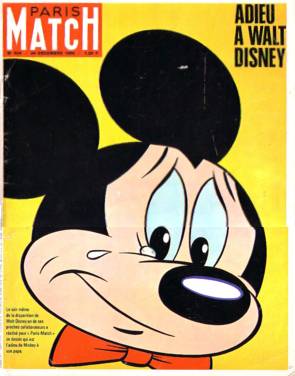
THE DEATH OF MAGIC

I am recalling an event that happened almost forty-five years ago today...

I am getting ready for school and, suddenly, there is my father calling up the stairs: "Brian, Walt Disney has died..."

Downstairs I heard the murmuring drone of radio voices as my father - busy brewing early morning tea - listens, as he does every morning, to the BBC news programme, Today.

I ought, perhaps, to have dashed downstairs to listen to the reports, absorb the details, gather up the tributes. After all, Walt Disney was my hero. A strange idol for a teenage lad, maybe - but that is what he was.

I collected every book, magazine and trivial snippet that I could find about Disney and his studio. I was forever copying pictures of Disney characters in my sketch-books - in fact my youthful ambition was to be a Disney artist, to animate those fabulous beings that appeared in his films. I longed to be a part of that mystical process that created characters out of ink and paint and then imbue them with a power to move people to laughter or tears. I was, I admit, obsessed by the man and his movies.

Later that morning, on my way to school, I would buy the daily newspapers and - in a corner of the playground at morning break - pore over the obituaries; but, at the moment of first hearing the news, I had only one response: I sat on the edge of my bed and wept.

For the first time in my young life I experienced that bizarre phenomenon: a feeling of overwhelming grief at the death of someone whom I did not really know. Not only had I never met Walt Disney, I had - rather surprisingly - never even written him a fan-letter. Yet, I felt - as doubtless many others have felt on hearing of the death of some public figure, president or pop-star - that I had lost a friend, been bereaved of someone who held a unique place in my affections. The loss felt achingly huge; a void had yawned open in my life that I doubted could ever be filled...

In the almost four-and-a-half decades since that day, I have continued to study - and occasionally write about - Disney's life and work. I have also had the privilege of meeting many of those who knew, worked with, loved and loathed the man. Such encounters have brought me very close to feeling that I understand at least something of the unique personality and character that was Walter Elias Disney.

But I have never been - never shall be - as close to him as I was on that morning when my father called upstairs to tell me the news that Walt Disney had died...

Sunday, 5 December 2010

THE MAN BEHIND THE MOUSE

This day, 109 years ago, saw the birth of a man who has probably had a more profound effect on my life and career than anyone else.

That man was WALTER ELIAS DISNEY...


My first exposure to the Works of Walt came in the early 1950s when, as a birthday treat, I was taken to a news-theatre (now long gone) on Waterloo Station. The programme included - in addition to Look At Life newsreel footage - a comedy short featuring Laurel and Hardy and a Disney cartoon...

On this fateful day, the chosen film was an already vintage Mickey Mouse short entitled Brave Little Tailor.


Originally issued in 1938, the film was based on the folk-tale of the tailor who accidentally gets appointed giant-killer.

Much of the film's classic knock-about humour was derived from the sequences following a scene in which the giant inadvertently swallows Mickey, along with an outsized handful of pumpkins, and then washes down his "meal" with the contents of an uprooted well...

At the sight of the intrepid Mickey swinging perilously on the Giant's giant uvula, the audience exploded with laughter - with one exception: ME! I was so totally terrified that I screamed the cinema down and, to my parents great embarrassment, had to be forcibly removed!

In the hopes of mollifying this traumatised child, I was whisked away to a Lyon's Corner House where, I am told, I stood on a chair and used my ice-cream spoon to conduct the band...

But, too late! The scars were already there and the seeds were sown for what has been a lifetime obsession with Disney's dreams and nightmares.

So – apart from pointing out the obvious dangers of taking young and impressionable children to the movies – what can I say but...

Thanks (and Many Happy Returns), Uncle Walt!