
Thursday, 28 July 2011
TIME-PIECE THURSDAYS: Disney Watches & Clocks
Where else but in Wonderland would you find a watch within a watch?


Thursday, 21 July 2011
MARY POPPINS (NEARLY) COMES BACK!

This post takes up a story that I began a few weeks ago...
Of course, it all happened a long time ago: twenty-four years ago, to be precise, in 1987...
For several years, I'd been friends with P L Travers the author of the 'Mary Poppins' books and, over tea one Sunday afternoon, we were discussing the latest in a long line of requests from Disney that they be allowed to make a sequel to their hugely successful, multi-Oscar winning movie starring Julie Andrews and Dick Van Dyke.

This particular proposal was for a film in which the magical nanny would make a return visit to help the children of either the grown-up Jane or Michael Banks. It was a clever idea, reminiscent of J M Barrie’s idea of having Peter Pan come back to London in order to take Wendy’s daughter - another ‘Jane’ - off to Never Land.
For Pamela Travers, however, it was totally unacceptable, since she resolutely maintained that all she knew about her heroine was whatever was to be found in the published stories. It was pointless asking Pamela who Mary Poppins was or where she went and what she did when she left the Banks family. Her answer was always the same: “I don’t know! I didn’t invent Mary Poppins, I discovered her!”
Knowing that I would be incapable of changing the author’s mind about the Disney offer, I merely observed that there were a great many people who loved the original film and would be incredibly pleased to see Mary Poppins fly back into the cinema one more…
“Well,” said Pamela whose prickly views of the Disney film of her books were widely known (and which you have read on this blog), “I would only agree if I was to be completely involved in the process of making the film and if I could work with someone whom I could trust.”
Then, after a lengthy pause, she looked at me and said, “But if you want to suggest to Disney that you and I might work on a film story for them, then go ahead and see what they say…”
So I did!
I didn't believe for a moment that it would actually happen, but I wrote to Walt’s nephew, Roy E Disney whom I had met and interviewed several times, and then forgot all about it.
This was in the days before e-mail, so it took a week for my letter to reach the Mouse Factory. At the time I was living with my parents and returning home late one night, I was greeted by mother telling me that there had been a message for me to ring Disney. Assuming she meant the studio's London office, with whom I had lots of dealings, I replied that I'd call first thing in the morning.
"No," insisted my mother, "you have to ring the American office, now!"
"But who do I have to ring?" I asked, "there are thousands of people working there!"
My mother looked at me as if I was an idiot and simply said, "Mr Disney, of course!"
Within half an hour I was having a conversation with an enthusiastic Roy Disney and within a matter of weeks, Pamela Travers and I were contemplating starting work on the project.
Before we began, I suggested it would be a good idea if we watched the original film together and I arranged for a screening at the Disney office, then in London's Soho Square. There were just the two of us in the small viewing theatre and, as the lights went down, I asked Pamela when she had last seen the film? "At the premiere," she replied and my heart sank.

That was twenty-three years earlier: if she was critical of the film based on two-decade-old memories, what would her attitude be on seeing it again? Might this not deal a death-blow to the whole project?
Not so, as it happened. The film ran and Pamela kept up a running commentary with some predictable complaints but a great many positive observations.
"That's something we should incorporate..." she whispered.
"That's good!" she announced, "Let's find an idea that recalls that moment..."
"Use that song as a reprise," she instructed. "Make a note of it!" And I did!
Days later, Pamela Travers and I were hard at work, drafting an initial outline, following the approval of which we went on to produce the first of two developed treatments.
One afternoon, the pair of us and our mutual agent entertained Jeffrey Katzenberg who had flown into town for the premiere of Who Framed Roger Rabbit. It was winter and the electric fire in Pamela's front room was running at full throttle, pumping out heat and making the atmosphere heavy and sleepy.
I learned an important lesson about powerful people being just like the rest of us as I watched Mr K fighting jet-lag and the oppressive heat while Pamela laid down demands about a series of issues such as the requirement that Mary Poppins must not (as she did in the first film) display her undergarments!
By sometime in the middle of 1988, to my enormous astonishment, I found myself in Los Angeles writing a Hollywood screenplay for a film to be called (after the second book in the series) Mary Poppins Comes Back!

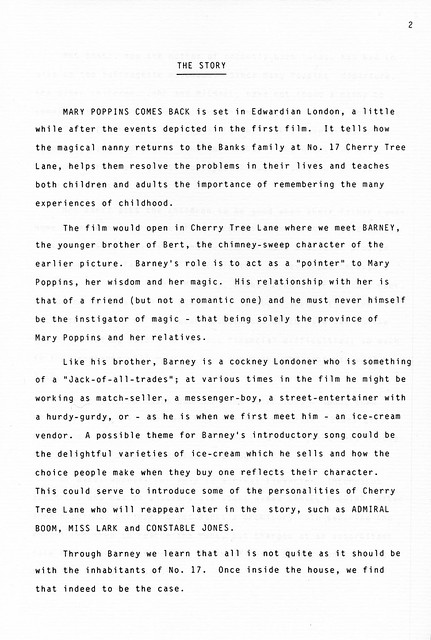
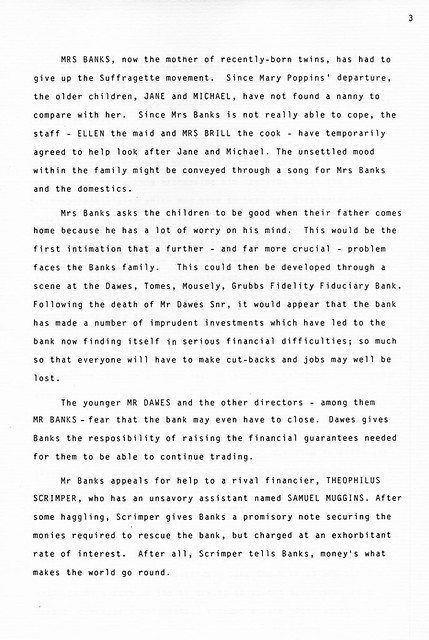
The story was to take place a little while after Mary Poppins' first visit. Mrs Banks had now given birth to twins, called (as in Travers’ books) John and Barbara, and during her pregnancy, had given up the cause of women's suffrage - an embellishment in the original film which Pamela had hated.
Mrs B was, nevertheless, as dizzy as ever, and not coping with her enlarged family; while Mr B was very wrapped up in his new position at the Bank and gravely concerned over problems resulting from various imprudent investments that had brought the bank to near ruin.
The children, predictably, were being fractious and troublesome...
One day, in the Park, Jane and Michael were having difficulty with their fly-away kite until - helped by Barney the Ice-Cream-Man - they finally managed to reel it in only to discover that holding on to the other end of the kite-string is the supercalifragilistic Miss Poppins!
Disney were hopeful that Julie Andrews might agree to reprise the title role - and, indeed, at that time she could easily have done that - but there were question-marks over the rest of the cast who were either grown up, too old or - er - dead!
When we began working on the project, P L Travers and I were expecting Bert to remain an important character - although Pamela was adamant that the romantic implications of the first film should not be repeated. However, in an early round of discussions with the Studio they suggested we look for an alternative character to act as "a pointer to Mary Poppins", which was PLT's phrase to describe Bert's function in the story.
We eventually decided to use the Ice-Cream Man, a minor character in the books, named him Barney and made him Bert's younger brother adding, by way of explanation, that Bert had gone on to "'igher things" and was now "sweepin' the chimblies of the rich and famous!"
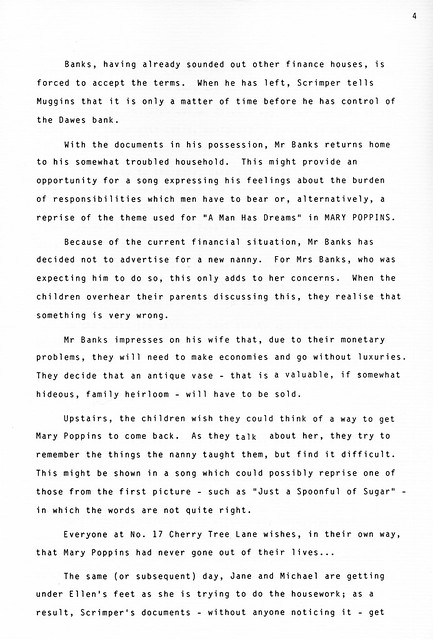
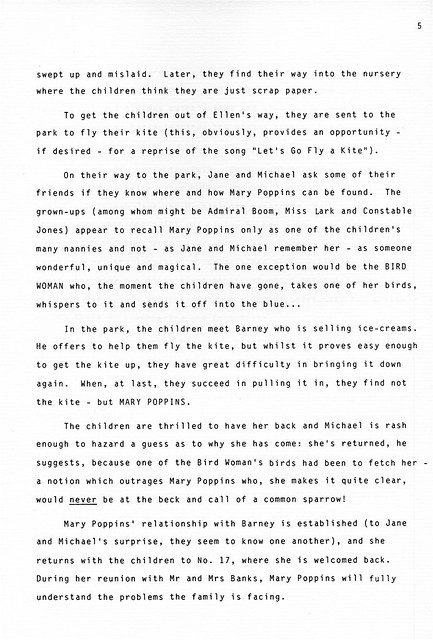
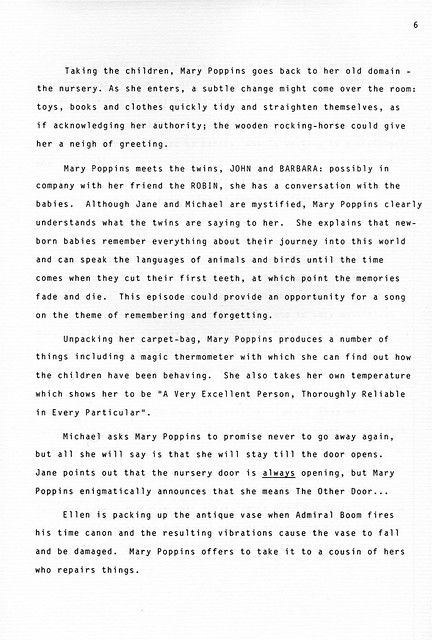
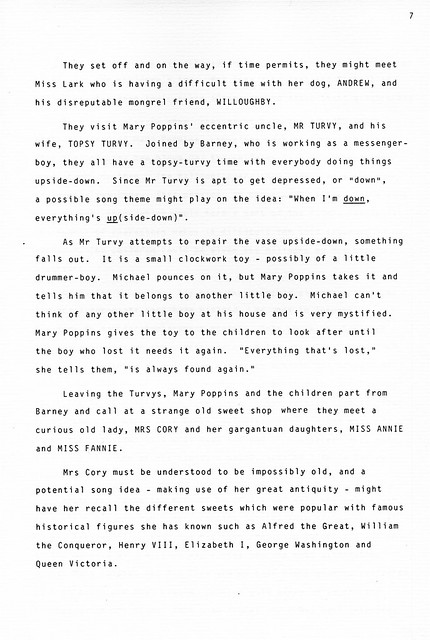
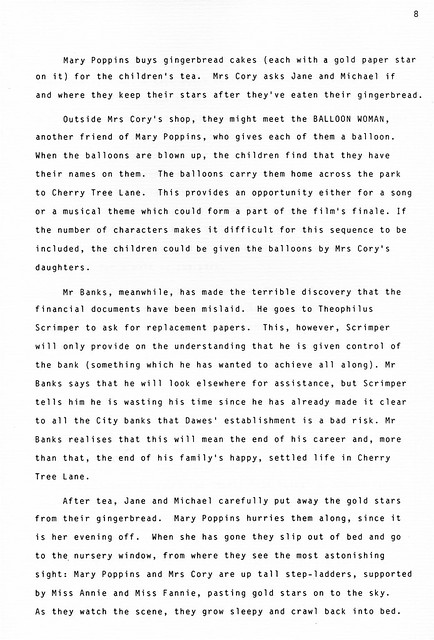
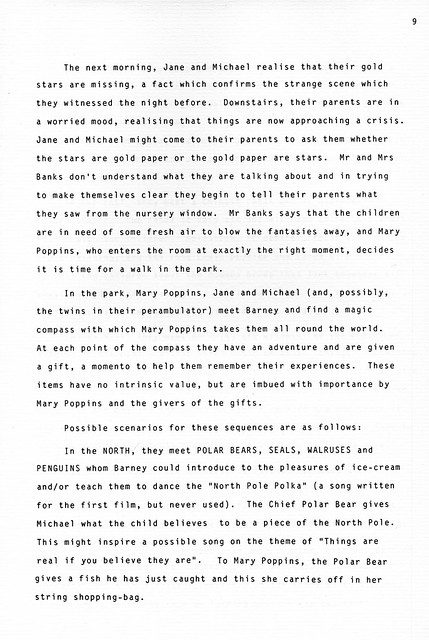
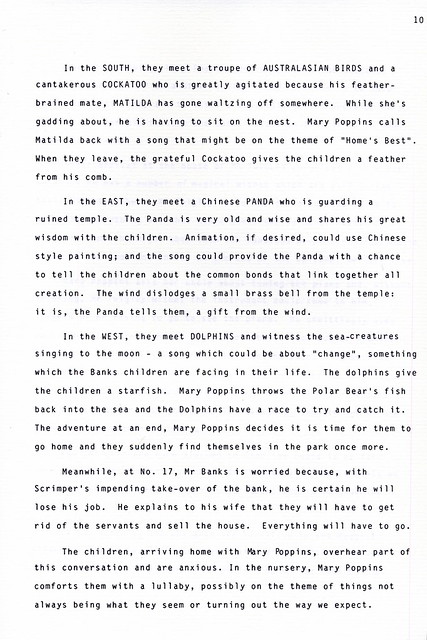
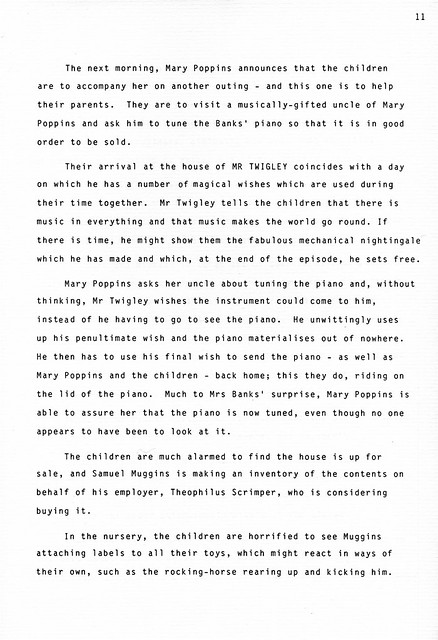
Here – hitherto unseen – is the second outline on which the two versions of then screenplay I wrote were based...
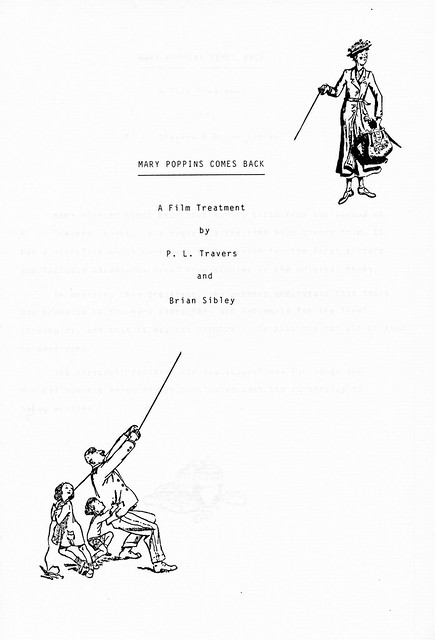
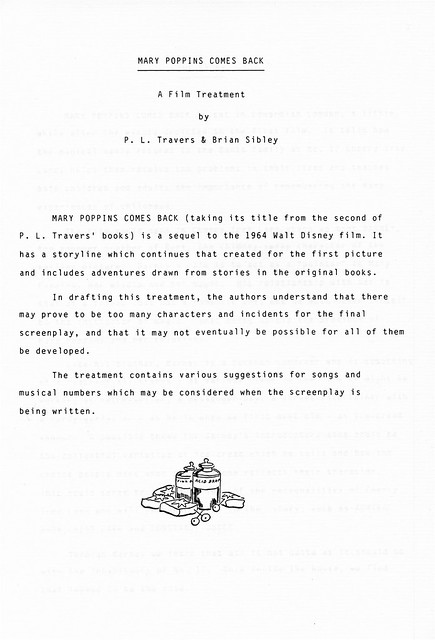
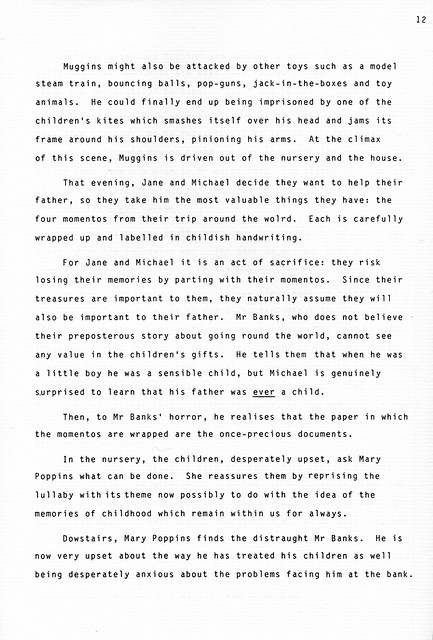
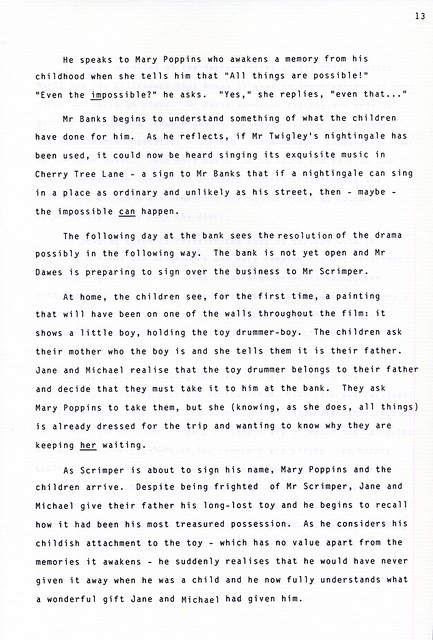
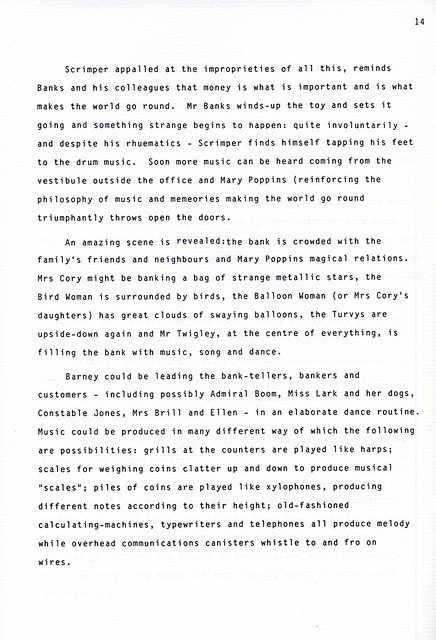
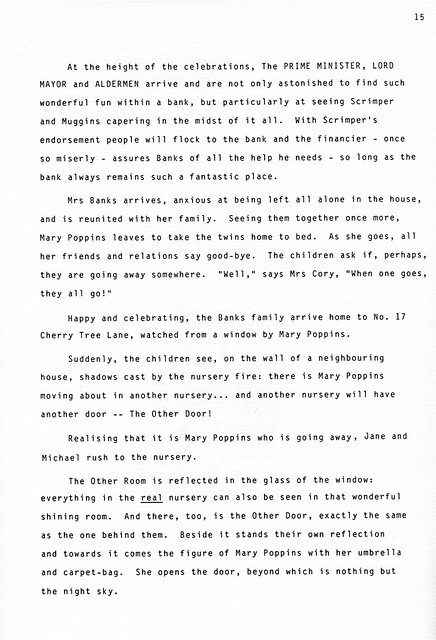
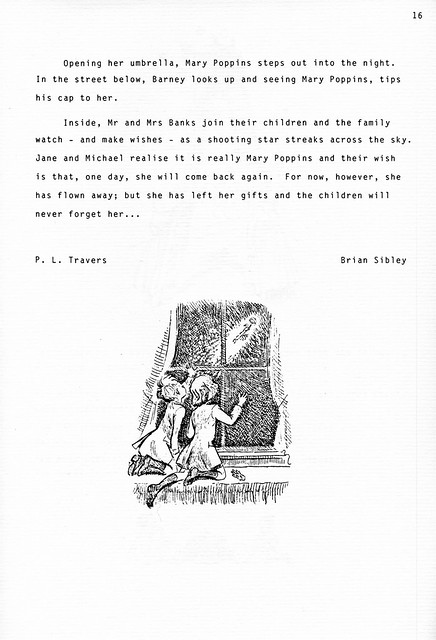
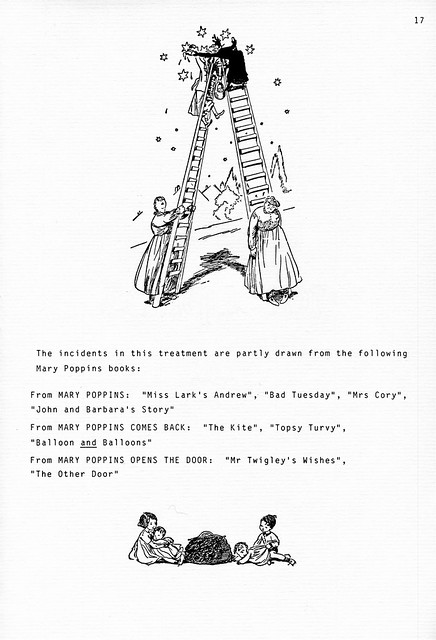
Changes in personnel at the studio led to the project being reviewed and passed to the Howze sisters (Penny and Randy) who had written the screenplay for Disney's 1988 movie, Mystic Pizza. Pamela and I were retained as advisers but, eventually, after another two draft screenplays, the project was shelved.
One small, but significant, plot feature from our original story finally made its way (without acknowledgment, obviously!) into the script of the stage musical of Mary Poppins, so – in a humble kind of way – our efforts were not entirely in vain!
Check out some interesting videos about Mary Poppins on my Sibley blog posting Something About Mary.
Monday, 18 July 2011
MICKEY MONDAYS: Weekly Manifestations of the Mouse
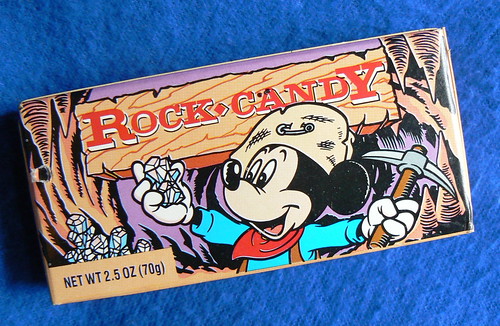
Something to steady the nerves while standing in line for Big Thunder Mountain...
Monday, 11 July 2011
MICKEY MONDAYS: Weekly Manifestations of the Mouse
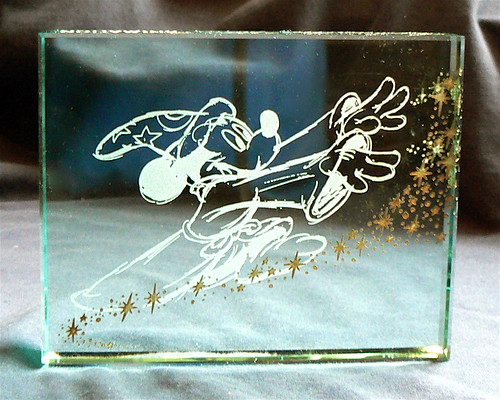
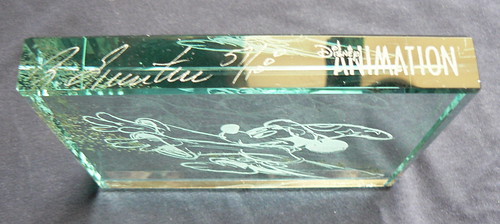
Engraved paperweight (limited signed and numbered edition) purchased at Disney Animation in Disney's California Adventure, Disneyland Resort, Anaheim, California.
Monday, 4 July 2011
MICKEY MONDAYS: Weekly Manifestations of the Mouse
To mark the fact that this 'Mickey Monday' falls on American Independence Day, here's Mr Mouse in his stars-and-stripes Uncle Sam costume, flying high over the Magic Kingdom at Walt Disney World in 1985...
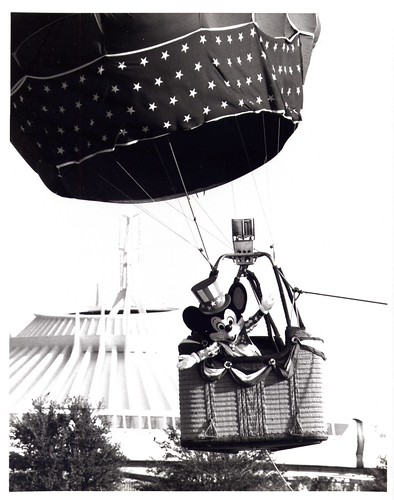
The caption to this publicity photo reads:
MICKEY SOARS FOR STAR SPANGLED SUMMER -- Radio City Music Hall Rockettes will join Mickey Mouse and many other stars for Walt Disney World's summer-long Salute to America in Epcot Centre and the Magic Kingdom. Fireworks, parades and stage shows are among many special events. The Rockettes will join Mickey on stage at America Gardens in the World Showcase with the All-American College Symphony Orchestra and celebrity guest stars from June 8 to Aug. 15. (Copyright WALT DISNEY PRODUCTIONS, 1985) 61 38 10A
The caption to this publicity photo reads:
MICKEY SOARS FOR STAR SPANGLED SUMMER -- Radio City Music Hall Rockettes will join Mickey Mouse and many other stars for Walt Disney World's summer-long Salute to America in Epcot Centre and the Magic Kingdom. Fireworks, parades and stage shows are among many special events. The Rockettes will join Mickey on stage at America Gardens in the World Showcase with the All-American College Symphony Orchestra and celebrity guest stars from June 8 to Aug. 15. (Copyright WALT DISNEY PRODUCTIONS, 1985) 61 38 10A
HAPPY 4th JULY!
Wednesday, 29 June 2011
SNOW WHITE AND THE GLASS DWARFS
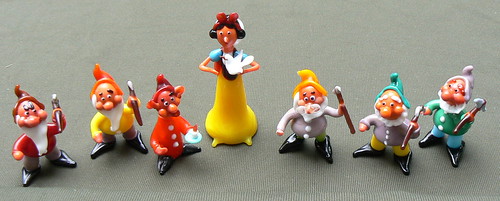
As frequent visitors to Venice, Italy, my partner and I have adopted a saying: "The Venetians will make anything in glass – because they can!" And this (non copyright approved) interpretation of the personnel from Walt Disney's Biancaneve e i Sette Nani is as good an example as any of what can be done.
Whether it ought to be done is, of course, another matter entirely!
Today's tourists will find the glass shops of Venezia (which are only rivaled in number by the mask shops!) are full of glass versions of more or less any cartoon character you can name: from Disney and Warner Brothers favourites to Peanuts and the Simpsons – most of which, sadly, are cheap imitations imported from Taiwan.
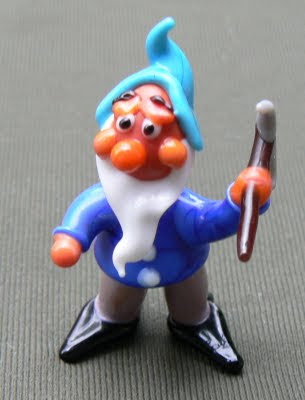
Fifteen years ago, however, on our first visit, they were somewhat rarer and we found this miniature set on the glass-making island of Murano. They don't quite follow the authorised style sheets and some of the individual dwarfs are considerably easier to identify than others...




Whether it ought to be done is, of course, another matter entirely!
Today's tourists will find the glass shops of Venezia (which are only rivaled in number by the mask shops!) are full of glass versions of more or less any cartoon character you can name: from Disney and Warner Brothers favourites to Peanuts and the Simpsons – most of which, sadly, are cheap imitations imported from Taiwan.
Fifteen years ago, however, on our first visit, they were somewhat rarer and we found this miniature set on the glass-making island of Murano. They don't quite follow the authorised style sheets and some of the individual dwarfs are considerably easier to identify than others...


Monday, 27 June 2011
MICKEY MONDAYS: Weekly Manifestations of the Mouse
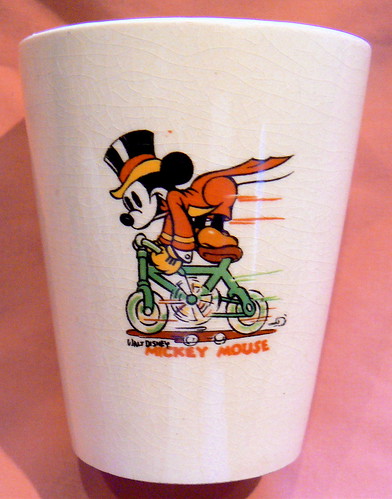
A piece of nursery crockery featuring the Mouse in the style of Mickey's Circus (1936).
Monday, 20 June 2011
MICKEY MONDAYS: Weekly Manifestations of the Mouse
When, in 1980, after more than two decades of dreaming, I finally managed to visit my first ever Disney theme park (The Magic Kingdom at WDW), I came back with a suitcase stuffed with souvenirs. It took a couple more visits before I realised the simple, basic truth: the Disneyana collector can never hope to own everything!
I confess that I have forgotten this lesson a couple of times: when, for example, I (briefly) began collecting pins and stopped when I was hounded round EPCOT by an almost hysterical collector tearfully offering me handfuls of dollars for a pin that had been given to the media and which wasn't on sale in the park!
I also admit that I made a substantial commitment to the Disney Classics Collection, until the number of pieces appearing were emptying my bank account and turning one room in my home into a depository for green boxes!
But, by and large, my principle has been DO NOT EVER buy something because you "have to have it to complete the set", because a set, by definition, is a finite thing and (in the merchandise-driven Disney-world) sets are always potentially infinite!
So, I do my best only buy those things that give me pleasure like this porcelain figure (purchased many years ago) of Fire Chief MM, loosely inspired by the shorts The Fire Fighters (b&w, 1930) and Mickey's Fire Brigade (colour, 1935)...
I confess that I have forgotten this lesson a couple of times: when, for example, I (briefly) began collecting pins and stopped when I was hounded round EPCOT by an almost hysterical collector tearfully offering me handfuls of dollars for a pin that had been given to the media and which wasn't on sale in the park!
I also admit that I made a substantial commitment to the Disney Classics Collection, until the number of pieces appearing were emptying my bank account and turning one room in my home into a depository for green boxes!
But, by and large, my principle has been DO NOT EVER buy something because you "have to have it to complete the set", because a set, by definition, is a finite thing and (in the merchandise-driven Disney-world) sets are always potentially infinite!
So, I do my best only buy those things that give me pleasure like this porcelain figure (purchased many years ago) of Fire Chief MM, loosely inspired by the shorts The Fire Fighters (b&w, 1930) and Mickey's Fire Brigade (colour, 1935)...
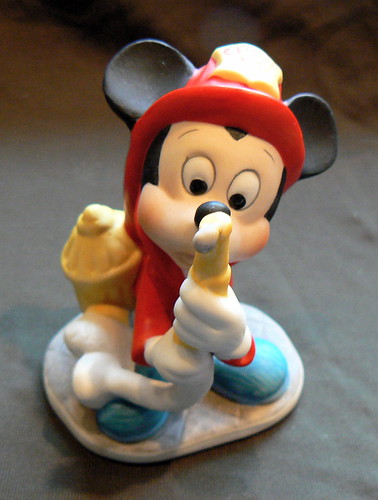
It's a cheap and cheerful piece (certainly when compared with the Classics Collection version), but I love the cross-eyed expression of Mickey unaware that the reason there is no water coming out of the hose is because there is a knot in it!
Thursday, 16 June 2011
MARY POPPINS AND THE SEA-CHANGE
 Having recently written on this blog about P L Travers, I decided to revisit my 'archive' (one of many cardboard boxes!) and found a couple of items that may be of interest to Disneyphiles and Poppinsites.
My correspondence with P L Travers began in 1972 when I was writing Disneydust, a never-published biography of Walt Disney.
I had been working on this book in my spare time (I was then an employee of a finance company) for four years, inspired to redress what I saw as the skewed portrait of Walt in Richard Schickel's The Disney Version.
Considering I was on the wrong side of the Atlantic, I achieved quite a lot original research and contacted a number of veteran Disney artists and employees, several of whom would later become longstanding friends.
Being something of a bibliophile, I also wrote to the authors of some of the books that had been made into films by the Disney studio, including Dodie Smith, Mary Norton, Margery Sharp –– and P L Travers, from whom I received the following letter...

Over the years, there has been much quoted comment about what was Pamela Travers' view of the the film. Here is how she expressed it in 1972...


Following her request, the statement was included in Disneydust in its entirety and Pamela read the chapter on the making of Mary Poppins and annotated it – extensively! As I have said, Disneydust never saw the light of day: abandoned by the publisher despite having advertised it in his catalogue of forthcoming titles – without my having a contract.
Fifteen years passed and I found myself working with Richard Holliss on The Disney Studio Story, for which I did have a contract! I wrote to Pamela asking if I could use her original statement in the forthcoming book. This is how she responded...


Part of Pamela's original statement eventually appeared in The Disney Studio Story (although heavily truncated since one-third of the text was lost in the edit) and my visits to 29 Shawfield Street continued and became more frequent until the day came when the subject of "another film" came up.
But that is a subject for another post...
Monday, 13 June 2011
MICKEY MONDAYS: Weekly Manifestations of the Mouse
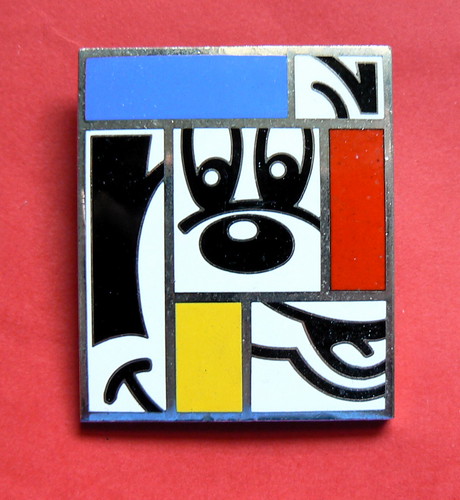
A Mickey Mouse pin-badge inspired by the paintings of Dutch artist, Pieter Mondrian. You will find further references to Mondrian the Mickey-takers on this post on Brian Sibley: His Blog.
Wednesday, 8 June 2011
TEA WITH MISS ANDREWS
 It's one of those occasions when you have to pinch yourself and ask, "Is this really happening?"
I'm sitting in a suite in London's Dorchester Hotel with Julie Andrews - yes, the Julie Andrews – Mary Poppins! – who is asking, "Shall I be mother?" and pouring me a cup of tea.
"Sugar?" Just a spoonful...
Thirteen years ago, 1998.
Radio producer, Malcolm Prince, and I are finally about to have an interview for which we've waited weeks. It's been on, it's been off and, now, it's back on again...
Julie is in London, rehearsing with the cast of the new musical, Doctor Dolittle, in which she is providing the voice of Polynesia the Parrot, and she's agreed to give us an interview for a radio series we're making on Disney's Women - the real and fictional women in the life and films of Walt Disney.
The evening of the interview eventually arrives. We are on time - well, absurdly early, of course! - but Miss Andrews is delayed. Detained at rehearsals....
An hour passes. Then another... We sit in the Dorchester bar, drinking over-priced orange juice, not daring to risk any alcohol - just in case the interview actually happens! I'm unaccountably nervous. It feels how, I imagine ,it would feel if you were waiting for an audience with the Queen...
I look at my watch. It's getting late. Miss Andrews is now stuck in traffic. The interview will definitely get rescheduled... Then the call to go up to her suite.
If possible, I am now even more anxious: at the end of a long day of rehearsals, she'll be tired, she'll be hungry. She's certainly never going to be able to give us the promised hour of her time...
In the suite we sit and wait some more. So near and yet so far... I hum to myself: "Fa - a long, long way to run..." How true.
Then the door opens and in comes Mary Poppins - spit-spot, hurry up, no dawdling...
She greets us with a big, warm smile and instantly defuses all anxiety. "Gentlemen! I am terribly sorry to be so late and to have kept you waiting!"
We shake our heads. Was she late? Had we been kept waiting? Really? We hadn't noticed!
Malcolm ventures that we'll try not to keep her too long. Again: the reassuring, I-have-confidence-in-sunshine, smile...
"I think we said an hour. Let's do it!"
Always the trouper, her on-with-the-show, vaudeville origins coming to the fore.
"But first, I need to freshen up - and then I think we all need a cup of tea!"
She vanishes into the bathroom, an assistant phones room-service and in a twinkling - only Disney magic could have done it quicker - a tray with a silver tea-pot and bone china tea-cups materialises before our eyes.
Then she's back, settling herself beside me on the sofa and asking if she should be mother...
Perfect! In fact, supercalifragilisticexpialidocious!
The interview - which flows effortlessly and runs for well over an hour- passes in a kind of hazy, pink blur...

Disney's Women was duly broadcast - to considerable acclaim - and, subsequently part of the interview relating to Mary Poppins found its way into an essay I contributed to A Lively Oracle, a book about Poppins' creator, P L Travers - which also published one of Andrews' fascinating (and revealing) letters sent to Travers from the Disney sound stage in Burbank.
When, a few years back, I wrote (with Michael Lassell) my book Mary Poppins: Anything Can Happen If You Let It
 , I'd planned to include part of what Julie had said about Walt, Mrs Travers and playing the practically perfect nanny. But word came down from on high in the Mouse's Kingdom that the Andrews references and quotes would have to go.
The only reason I supposed that this curious decision had been taken - for Julie's presence in the film was crucial not just to the movie itself, but also to her own future career - was that, for some time she had been reportedly working on her autobiography. Maybe she was anxious that we didn't preempt her own book... Who knows? Anyway, the problematic passages were excised and that was that.
And, once again, I waited for Miss Andrews - or, rather, this time, for her book!
When Home: A Memoir of my Early Years eventually arrived, it was, as you'd expect (as you probably know), a charming read. But it's much more than that, being uncompromisingly honest - whilst remaining, as she would say, "polite and decent".
Home proved to be jam-packed with insightful stories: the benefits and pitfalls of being a born-in-a-trunk child star; singing (aged 13 years) for Queen Elizabeth and Princess Elizabeth at a Royal Command performance on the stage of the London Palladium; appearing on radio with Peter Brough and his wooden-headed companion, that other Andrews - Archie...

Getting the role of Polly Browne in the first Broadway production of Sandy Wilson's The Boy Friend (as a result of a recommendation from fellow Educating Archie regular, Hattie Jacques); and, later, her fairy-tale romance with Tony Walton; playing opposite Richard Burton and Roddy McDowell in Camelot and becoming friends with T H ('Tim') White, the idiosyncratic author of The Once and Future King, the book on which the musical was based.
 And, of course, there were the chapters that will doubtless excite most interest - her experiences during the creation of Lerner and Loewe's classic musical, My Fair Lady. It was fascinating to learn, incidentally, that they nearly called their show Fanfaroon - a man who blows his own trumpet! All things considered it's probably just as well that they didn't...
In those chaptrers, Julie revealed the monstrous egocentricities of Rex Harrison, the lovableness of Stanley (Alfred Doolittle) Holloway and Robert (Colonel Pickering) Coote, the utter beastliness of designer, Cecil Beaton and the devoted, nurturing care and attention which director Moss Hart showed towards his inexperienced young star at a point when everyone - and, in particular, the monstrous Rex - considered her a total liability and the show's undoubted ticket to the graveyard of theatrical flops and failures...
"She'll be fine," Hart told his wife after 48 hours of ceaseless coaching, "she has that terrible British strength that makes you wonder how they ever lost India."
Of course, what I was most interested in was what she would say about Poppins? Would it differ in some crucial way from my own interview account? But, no! There it is, virtually word-for-word as it was told to me over the teacups in the Dorchester...
The first volume concluded with Andrews getting the Poppins role, so there's plenty more to come in volume two: The Sound of Music, Thoroughly Modern Millie, Star!, Darling Lili, Hitchcock and Torn Curtain, Blake Edwards, S.O.B. and Victor/Victoria and the story of what happened to that extraordinary voice - not to mention the Shrek and Princess Diaries movies.
Anyway, since the book is now long published, it's probably safe to reveal that expurgated text.
So, here it is...
 It was Walt's secretary, Tommie Wilck, who suggested Julie Andrews, the young British singer who had achieved stage stardom in London and New York as Eliza Doolittle in My Fair Lady, and who was currently appearing on Broadway as Queen Guinevere in the musical, Camelot.
There!
Towards the end of 1961, returning from a visit to Europe, Walt stopped off in New York to see a performance of the Arthurian romance. As Julie Andrews sang, danced and whistled her way through the show stopping number 'What Do the Simple Folk Do?', Walt was convinced that he had found his Mary Poppins.
Backstage, after the show, Walt talked enthusiastically about his plans for the film. “There was no preamble,” Julie recalls, “he said he’d loved the evening and he wanted to talk to me about a project he had in mind for the film of Mary Poppins. I said, ‘Well that sounds lovely’. I don’t remember having had doubts other than ‘Can I make a movie?’ This would be my very first picture and as much as I’d always wanted to go into film I thought, ‘Gosh, would I be able to do it justice? Would I be any good at it?’ and so on.”
However, Walt was persistent and Julie agreed that, once Camelot had ended its run, she would visit the Disney studio with her then husband, designer Tony Walton. Meanwhile, she read the books and began to have doubts not just about her own ability but also about the possibility of adapting the source material for the screen.
“The books were so perfectly written,” she recalled, “but they were so boxed-in with their primness and rigid discipline that I thought ‘Now, how are they going to make that into a musical?’ And, of course, it was miraculous the way that they did.”
Any lingering anxieties were dispelled when she and Tony Walton arrived in Burbank at what Hollywood referred to as ‘The Mouse Factory’: “The minute I walked into the studio and saw what Walt had prepared, I could tell that Poppins had something special about it.”
Looking at the storyboards and hearing the songs convinced Julie that she should accept the role: “The thing that was wonderfully appealing was that my background, long before I had been on Broadway, was vaudeville and music-hall. And the songs they played me on that first day, were wonderfully reminiscent. They had that knock-down, drag-out quality of the good old vaudeville songs and I loved them!”
About one song only, Julie had reservations: it was the ballad 'The Eyes of Love' which the Sherman brothers had come to think of as Mary Poppins' theme. She, however, thought the song too sentimental and not very 'Poppinsish'. In an attempt to find an alternative, the composers drew on an experience of Robert Sherman's younger son who had recently been given an inoculation at school that had been disguised with a spoonful of sugar. The resulting song became one of the most popular in the film.
Walt hoped to clinch the deal by offering Julie $125,000 and asking Tony Walton to be the film's design consultant, but there was one lingering issue: she was still under consideration for the role of Eliza Doolittle in the screen version of the show that had made her name My Fair Lady.
Julie wished more than anything to play on film the role she had created on stage, but Walt wanted her to be Mary Poppins and was so eager for her to commit to the film, that he promised to release her from her contract if Warner Brothers offered her the part in My Fair Lady. In the event, Jack Warner decided that casting Julie was too big a box-office gamble (having Rex Harrison play Professor Higgins was even thought risky) and opted, instead, for the glamorous, but non-singing, Audrey Hepburn. Warner's loss was Disney's gain.
P L Travers had described Mary Poppins as being thin, plain and “rather like a Dutch doll”, with “large feet and hands, and small, rather peering blue eyes.” Although Julie Andrews, at twenty-seven, was considerably prettier, she skilfully captured much of Poppins’ enigmatic personality, described by the author as “a mixture of arrogance and poetry and, underlying both, a certain invincible integrity.”
Julie, who was pregnant, returned to England to give birth and, thirty-six hours after the arrival of her daughter Emma, she received a phone call in hospital: “They said, ‘There’s a Mrs Travers on the line for you,’ and I thought, ‘Oh I’d better speak to her, doesn’t anybody know that I’ve just given birth and I’m feeling a bit weary.’ And she came on, she said, ‘Hello, this is P L Travers, is this Julie Andrews? Talk to me! I want to hear what you sound like.” I said, ‘Well what can I tell you, Miss Travers, I’m very thrilled, I believe I’m going to be doing a film based on your books.’ ‘Well,’ she said, ‘you’ve got the nose for it that’s for sure; you’re too pretty, but you’ve got the nose for it.’”
Later, Julie went to afternoon tea with Pamela and still remembers her assessment of the author: “I liked her, she was an eccentric and rather tough old girl but a good hearted one I felt.” Pamela was equally responsive to Julie and - whatever her subsequent reservations about the film - was unfailing in her praise of the actress, describing her as having “integrity and a true sense of comedy” and her performance as showing that she understood “the essential quality” of Mary Poppins.
That's what you didn't read in the Poppins book although, in her autobiography, Julie Andrews has told the tale in her own words - which are pretty much just about the same!
Home only takes the Andrews story as far as the Walt Disney engaging her to play Mary Poppins and that curious maternity wing telephone conversation with P L Travers...
I actually wrote quite a bit more written about the filming and the Oscar-winning success of Mary Poppins, but since Ms A is at work on a second volume of autobiography, I guess I'd better - for the present - keep that to myself!

Subscribe to:
Posts (Atom)



.jpg)

.jpg)


